

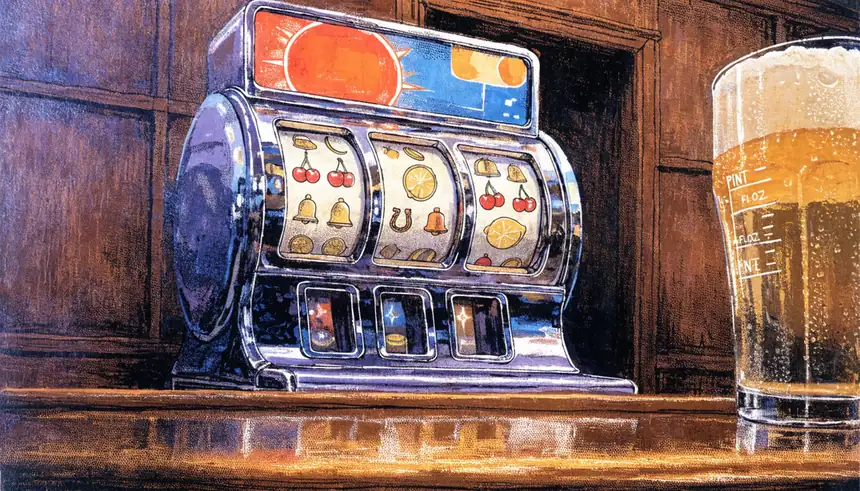
RTP combines a game’s possible outcomes into a long-run measure, not a forecast for an individual session.
What a Slot Payout Percentage Actually Measures
A slot payout percentage is a way of describing how much of the money staked on a particular game is designed to return to players over a very large number of plays. It is also called the payback percentage or, in many casino guides, the theoretical return. The wording varies, but the basic idea is the same: it describes the game’s long-run mathematical behaviour, not the result you should expect from your next spin.
That distinction matters because people often use “casino payout percentage” as if it were a single figure covering everything on a website. It is not. A payout percentage belongs to a game, a configured version of that game, or sometimes a defined group of games. It does not automatically describe every slot in an online casino, and it says nothing precise about the result of one person’s short visit.
What the percentage refers to
A slot uses its rules, symbols, paylines or ways to win, bonus features and prize table to determine possible outcomes. The payout percentage brings all of those possibilities into one theoretical measure. It considers the frequency of winning outcomes and the value of their prizes, then relates the expected return to the total amount staked.
If a game’s stated payback percentage were applied to a sufficiently large body of play, the mathematical return would tend towards that figure. “Sufficiently large” is doing important work here. The measure only becomes meaningful across a huge volume of spins, not after a handful of attempts at a pub machine or a few minutes on an online slot.
This does not mean the game keeps a fixed slice of every stake. A slot does not watch your balance and arrange for the advertised percentage to come back to you gradually. One spin may produce no prize, another may produce a small win, and another may produce a much larger one. The percentage is calculated across the game’s designed outcomes, not assigned separately to each player or each spin.
Online Casino Games: Slots, Live Tables and More
Why one session can look completely different
Imagine two people playing the same slot under the same rules. One may finish a session ahead because a feature or winning combination arrived early. Another may lose the same amount of money without seeing a meaningful prize. Both results can occur without either one contradicting the game’s theoretical payout percentage.
Short sessions are dominated by chance. The number of spins is too small for the broad mathematical pattern behind the game to show itself reliably, and the size and timing of wins can make individual results look very different. A player can therefore receive more than the theoretical return, less than it, or nothing back during a particular session.
That is why a payout percentage should not be read as a promise that part of your stake will be returned before you stop playing. It is not a refund rate, a target for your account, or a prediction of what your balance will show after a selected number of spins. It is a property of the game’s probability model.
The same point applies to the phrase “best casino payout percentage”. A casino may offer games with different theoretical returns, but a high figure attached to one title does not make the result of your own session more favourable in any guaranteed sense. Nor does it turn the casino into a single game with one universal return figure.
Online and physical slots
The principle is the same whether you are looking at an online slot or a traditional casino slot machine. In both cases, the percentage describes the mathematical design of the game rather than the personal outcome of a player. Online play simply presents the information in a different setting, often through the game’s help screen, information panel or published rules.
Do not confuse the percentage with the amount currently being paid out by a machine or website. A game’s recent results do not rewrite its underlying design. A run of wins does not establish that the slot is “hot”, while a run of losses does not prove that a win is due. Each game cycle is governed by its own random outcome process.
For British players, online casino gambling sits within a regulated market overseen by the UK Gambling Commission.
For British players, online casino gambling sits within a regulated market. The UK Gambling Commission oversees commercial gambling in Great Britain, including remote gambling offered to consumers there even when the operator’s technical equipment is located elsewhere. It is the country’s sole regulator for commercial gambling, issuing operating licences to businesses and personal licences to individuals working in the sector. That regulatory role concerns the operation and control of gambling services; it does not turn a theoretical game statistic into a personal guarantee.
What to take from the figure
When you see a slot payout percentage, treat it as a comparison point for the game’s long-term mathematical return. It can help you understand how the game has been designed, but it cannot tell you what will happen during a short session, which player will win, or when a particular feature will appear.
The useful habit is simple: identify whether the figure belongs to the individual slot, then keep it separate from your own result. The game has a theoretical return. You have a session outcome. They are related, but they are not the same thing.
Slot RTP: A Long-Run Measure, Not a Session Promise
RTP stands for return to player. On an online slot, it is the theoretical proportion of all stakes that the game is designed to return over a very large number of plays. That wording matters. RTP describes the game’s long-run mathematical behaviour, not the result you should expect from your own visit.
Fast Payout Online Casinos in the UK: What to Check
If a slot displays an RTP of a particular percentage, that figure belongs to the game as a statistical model. It is calculated from the symbols, winning combinations, bonus features and other rules built into the software. The calculation considers the possible outcomes and how often they are expected to occur across an enormous volume of spins. It does not watch your balance and adjust the next result to bring you closer to the advertised return.
That is the first trap with online slots payout percentage. People often read it as though it were a personal refund rate. It is not. RTP is closer to a description of the game’s long-term pattern than a promise attached to each player.
What “long run” means in practice
A slot can produce results that sit far above or far below its theoretical RTP for a long time. A player might hit a large win early, while another player might stake repeatedly without receiving anything comparable. Both experiences can occur on the same game without contradicting its published return.
The reason is that individual spins are subject to chance. A game’s mathematical model may contain frequent small wins, rare large wins, bonus rounds or long gaps between notable results. The RTP combines all of those possible outcomes. Your session contains only a small slice of them, and that slice may look nothing like the overall model.
Even a long personal playing history should not be treated as a private account that must eventually settle at the stated percentage. As more plays are considered across the relevant population, the observed results may tend towards the theoretical figure. That does not mean every individual player, account or session is pulled towards it in a predictable way. Statistical convergence is not a repayment schedule.
I find this easiest to remember as a property of the game, not a target for your balance.
Understanding RTP
RTP is a property of the game’s mathematical design, not a personal refund rate or a target for your balance.
Why the displayed figure needs context
The RTP attached to a slot may apply to a particular configuration of that game. Some titles are released with more than one return setting, and the version available through one operator may not necessarily use the same setting as a version found elsewhere. The important point is to identify the RTP for the actual game configuration you are opening, rather than relying on a figure copied from a general description.
The game’s information panel, rules screen or paytable is the sensible place to look. Read the details alongside the symbols and feature rules. A headline figure on a review page can be incomplete if it does not make clear which version, mode or rule set it describes.
This also explains why a slot’s RTP is not a measure of how generous a particular casino feels on a particular day. The figure is tied to the software and its mathematical design. It is not a live score for the operator, and it does not rise because you have been losing or fall because someone else has won.
RTP does not describe the shape of the ride
Two slots can have the same theoretical RTP while producing very different playing experiences. One may return value through many modest wins; another may rely more heavily on occasional, much larger outcomes. The RTP alone does not tell you how often wins appear, how large they may be, or how severe the losing stretches can feel.
That is why treating the highest-looking payout percentage online as an automatic answer is too simple. A return figure says something important about the long-run model, but it does not describe every feature affecting the session. The game’s volatility, hit pattern and bonus structure can change how results are distributed, even when the theoretical return is similar.
Bonus Buy Slots in the UK: How the Feature Works
None of this makes RTP meaningless. It gives you a consistent way to compare the mathematical return stated for different slot configurations. It can help separate a game’s designed long-run return from marketing language or from a memorable personal result. It simply needs to be read at the correct scale.
A figure for comparison, not forecasting
When you compare online casino slots, use RTP as one piece of information about the underlying game. Ask what exact version the figure belongs to and whether the rules or feature structure match what you are about to play. Then keep the distinction clear: the percentage describes expected behaviour across a vast number of outcomes, while your result is determined by the particular spins you receive.
A winning session does not prove that the slot will keep paying at that level. A poor session does not prove that the game is withholding a win that it owes you. The RTP has no memory of either result, and the next spin is not made more favourable by earlier losses.
That is the practical meaning of a long-run measure. It can describe the mathematics without predicting your evening.
Why a Casino-Wide Payout Figure Can Mislead
A casino-wide payout percentage describes the operator’s games as a group. A slot’s RTP describes one game. Those figures may sound interchangeable, but they answer different questions.
When I see a figure attached to an online casino, I first ask what has been included. Does it cover slots only, or also table games, live casino, bingo, and other products? Does it relate to one reporting period, or a longer stretch of activity? Without that context, the percentage is difficult to compare with the RTP shown for an individual slot.
Do
- Identify the specific RTP for the game configuration you are playing
- Treat payout figures as a comparison point for long-term mathematical returns
Don’t
- Assume a casino-wide payout figure applies to every individual slot
- Treat a high payout percentage as a guarantee of your personal session outcome
One operator, many different returns
An online casino may offer games with different mathematical settings. One slot can have a different theoretical return from another, even when both are available through the same account. Table games and other casino products are calculated in their own ways as well. Combining them creates an operator-level result, not a universal setting applied to every game.
That is the important distinction. A casino-wide figure cannot tell you the stated RTP of the particular slot you open. Nor can the RTP of one slot describe how the whole operator performed across every game and customer during a reporting period.
The same problem appears when people look for the highest payout percentage online casino or the highest payout percentage online casinos. A large published figure may reflect the mix of games played, the stakes placed, and the period covered. It does not automatically show that every slot at that casino has the same return. Marketing departments do enjoy making one number do several jobs.
Why the average can move
An operator-wide payout figure is an aggregate. It is shaped by actual play across the casino rather than by the theoretical design of one title. If customers spend more time on one group of games than another, that balance affects the combined result. The outcome can also differ between reporting periods as the pattern of play changes.
Video Slots in the UK: What Makes Them Different
That makes an average online casino payout percentage a description of past or combined activity, depending on how the operator defines it. It is not a shortlist of the highest paying online slots, and it does not establish which games have the highest RTP. To make that comparison properly, you need the stated information for each individual game, presented on a like-for-like basis.
The word “average” matters here. An average can summarise a collection without matching any single member of it. The casino-wide result might not be the figure attached to any particular slot. Treating it as though it were can make an ordinary game look stronger than its own published information supports.
Check the scope before comparing figures
Before relying on a payout figure, look for the label and the population behind it. Useful details include:
- which games are included;
- whether the figure covers the casino as a whole or one game;
- the period to which it relates;
- whether it is a theoretical setting or a result calculated from actual play;
- whether different versions or configurations are treated separately.
The wording around the number matters as much as the number itself. “Casino payout” and “slot RTP” are not two labels for the same measurement. One may summarise activity across an operator’s portfolio; the other belongs to a specific game’s mathematical model.
This is also why broad claims about the highest RTP online casino slots need careful reading. A casino cannot inherit a slot’s RTP simply because it hosts that slot, and a slot cannot inherit the casino’s overall payout figure. The figures sit at different levels: one concerns the operator’s combined activity, while the other concerns the design of a particular game.
If you want to compare slots, keep the comparison at slot level. If you want to understand an operator-wide figure, treat it as an aggregate report and read its scope first. Mixing the two creates a neat-looking comparison with no solid foundation.
Slot Payback and the House Edge Are Two Sides of the Same Figure
A slot’s payback percentage and its house edge are not two separate charges built into the same game. They describe the same theoretical outcome from opposite directions.
House Edge
The portion of the stake that is theoretically expected to remain with the casino over the long run.
Payback asks: what share of the money staked is expected to return to players over the long run?
House edge asks: what share is expected to remain with the casino over the long run?
That is the whole relationship. One describes the player’s theoretical return; the other describes the operator’s theoretical advantage. If you know one figure, you can work out the other by taking it away from the complete amount staked. No second advantage is hiding behind the wording.
Payback and house edge in plain English
Suppose a slot is described as having a particular theoretical return. That return is expressed as a percentage of stakes across a very large number of spins. The part not represented by the payback is the casino’s mathematical edge.
So, when you compare RTP versus house edge, you are not comparing two competing measurements to decide which one is “better”. You are translating between two labels:
- RTP or payback describes the portion theoretically returned through prizes.
- House edge describes the portion theoretically retained by the casino.
- The two figures are complements, meaning that together they account for the entire stake in the model.
This is why a larger payback corresponds to a smaller house edge, while a smaller payback corresponds to a larger house edge. They move in opposite directions because they are looking at opposite sides of the same calculation.
The wording can make this sound more complicated than it is. “Payback” feels player-focused, while “house edge” sounds operator-focused, but neither term changes the underlying game mathematics.
A simple way to translate the terms
When a slot’s return is supplied as a percentage, read it as the theoretical player share. To find the casino share, subtract that percentage from the complete stake. When the casino share is supplied instead, reverse the process: remove the edge from the complete stake to find the theoretical payback.
There is no need to add the two percentages together as though they were separate deductions. Doing that would count the same built-in margin twice.
This also explains why comparing a slot machine payout percentage with a slot machine house edge percentage can be misleading if the labels are not checked carefully. A payout percentage might refer to the game’s theoretical return, whereas a house-edge figure refers to what remains for the casino. They may look like different statistics on a comparison page, but they are usually two ways of presenting the same relationship.
The important word is theoretical. The calculation describes the game over an extensive run of play, not the result of your next spin or the balance shown after one visit.
What the calculation does not measure
The house edge is not a prediction of how much you will lose during a particular session. If you stake money on a slot and receive a prize, your personal result depends on the spins you actually play and the outcomes that occur. You might finish ahead, below your starting balance, or somewhere in between. The theoretical edge does not force every player’s session to match it.
Attention The house edge is not a prediction of how much you will lose during a particular session; personal results depend on the spins you actually play.
The same caution applies to the payback figure. It does not mean that each spin returns the stated share, or that your deposits will be returned in that proportion. Slot outcomes are not distributed as a smooth refund. Prizes arrive in varying sizes and at varying points in the game’s sequence, while losing spins can occur between them.
That is why a game can have a stated payback and still produce a very different result for an individual player. The longer-run model and the short-term experience are different things. The calculation connects the two terms; it does not turn either term into a personal forecast.
Do not confuse edge with winning frequency
Searches for a slot machine winning percentage or slot machine hit frequency often point towards another statistic. Hit frequency concerns how often a spin produces a winning outcome under the game’s definition of a win. It does not tell you how much those wins are worth.
A slot could produce frequent small wins while still having a meaningful house edge. Another could produce wins less often, with prizes arranged differently. Neither hit frequency nor the number of winning spins automatically reveals the payback or the house edge.
This distinction matters because “a win” is not the same as “a profitable spin”. A prize may be smaller than the stake used for that spin, and a session result depends on the complete sequence rather than on a simple count of winning outcomes. The house-edge calculation deals with the theoretical value returned against the value staked, not merely with how often the reels display a winning combination.
Three-Reel Slots in the UK: Features and Play
So if a game description mentions hit frequency, treat it as information about the pattern of wins, not as another name for RTP.
Why the wording still matters
Terms such as slot machine payback percentage, online slots house edge and slot hold percentage can appear in different parts of a casino explanation. Before comparing them, check what the percentage is actually measuring and whether it applies to a particular game or to a wider group of activity.
For an individual slot, payback and house edge should point in opposite directions. A payback figure is player-facing; the corresponding edge is casino-facing. They should not be presented as independent disadvantages, and they should not be combined to create a larger cost.
I find it easiest to keep one sentence in mind: payback is the theoretical return, while house edge is the theoretical amount left over for the casino. The labels change; the underlying relationship does not.
What a Slot Pays Back—and What It Doesn’t Promise
A slot’s payout percentage describes a theoretical share of the money staked that the game is designed to return over a very large number of plays. It is a property of the game’s mathematics, not a personal result waiting to be collected. That distinction matters more than the neatness of the percentage shown in the information panel.
If a slot displays a particular return figure, it does not mean that each spin gives back the same proportion of your stake. A spin may produce no win, a small win or a much larger one. The percentage does not divide your stake into a predictable allowance, and it does not tell you which outcome is due next.
What a payout percentage is NOT
A payout percentage is not a savings rate where you receive a predictable share of your stake back. It does not divide your stake into an allowance, nor does it tell you which outcome is due next.
This is where many otherwise sensible comparisons go off course. Someone sees an online slot payout percentage and treats it like a savings rate: put money in, receive the stated share back. A slot does not work that way. The figure summarises how the game is expected to behave across its mathematical model, while your session is only one brief slice of that model.
What the percentage can tell you
The figure gives you a basis for comparing the stated theoretical return of one slot with another. If two games publish different payout percentages, the higher figure represents the more favourable theoretical return under the relevant game rules. It is useful information when you are deciding which titles deserve a closer look.
It can also help you understand what “high payout” means in this context. It does not mean frequent wins, large wins or a session that ends in profit. A game can return money through many modest wins, occasional larger wins or a mixture of outcomes. The percentage alone does not describe that pattern.
Nor does it tell you how long your balance will last. The result depends on the sequence of outcomes, the stake you choose and whether any winnings are put back into play. Two people can play the same slot under the same published terms and finish with entirely different results. Mathematics has no obligation to make the evening feel symmetrical.
What it cannot promise
A payout percentage cannot guarantee a return on your next spin, your current deposit or your whole session. It cannot identify a winning moment, predict a particular prize or ensure that you will recover what you have staked. It also cannot turn a losing run into evidence that a win is now owed.
5-Reel Slots in the UK: Features and Gameplay
Past results do not change the meaning of the game’s stated percentage. A series of losses is not a signal that the next play must compensate you, just as a recent win does not make another win more likely. Treating either pattern as a promise is a mistake.
So, are online slot payout percentages accurate? They can accurately state the game’s theoretical return when the figure belongs to that specific version and its published rules. Accuracy does not make the figure a forecast for an individual player. Read it as information about the game, not as a receipt for money you are certain to get back.
How to Read an Online Slot’s RTP
When an online slot displays an RTP figure, read it as a property of that particular game configuration, not as a promise attached to your account. The percentage describes the theoretical proportion of stakes the game is designed to return over a very large number of plays. It does not tell you what your next spin, evening or deposit will produce.
The first practical check is to confirm that the figure belongs to the version you are actually playing. Some games are released with different RTP settings, and the information panel may show the selected configuration rather than a single figure that applies everywhere. Open the game’s help or paytable screen and look for its rules, return information and any available settings. If the details are unclear, treat the figure cautiously rather than filling in the gaps yourself.
Checking RTP
- Confirm the RTP belongs to the specific version of the game you are playing
- Check the game’s help screen or paytable for official return details
- Read the RTP alongside information about the game’s volatility
Payout percentage versus RTP
In ordinary slot discussions, “payout percentage” and RTP often refer to the same theoretical return. RTP is the more precise term used in game information and technical descriptions. Neither figure is a forecast of your personal result. A displayed percentage is not a refund rate for one session, and it does not mean that the machine will balance your losses after a run of unlucky spins.
That distinction matters when comparing games. You are comparing their stated long-term mathematics, not ranking the likely outcome of your next few minutes. A slot with a higher listed RTP can still produce a losing session, while one with a lower figure can produce a win. Short-term results do not politely follow the spreadsheet.
Read RTP alongside volatility
RTP is only one part of the information. Volatility describes how the game’s results tend to be distributed: a lower-volatility slot may produce more frequent, smaller wins, while a higher-volatility slot may produce wins less often but with larger swings. These are broad characteristics, not guarantees. A high-volatility game is not automatically better, and a lower-volatility game is not automatically safer for your balance.
High-Volatility Slots in the UK: How Payouts Work
Think of RTP as the game’s long-run return setting and volatility as the shape of the journey towards that return. Two slots can show a similar RTP yet feel entirely different because their win patterns and bonus features are structured differently. Conversely, a different RTP does not tell you how quickly a particular session will move up or down.
Finally, check whether the displayed information relates to the base game, bonus features and any selectable options as a whole. Keep your stake within the limits that apply to your age group in Britain, remember that autoplay is not available for online slots, and use the account limit tools provided by the operator. Those controls do not alter the RTP, but they do stop a theoretical percentage from becoming an excuse to chase a result.
Why There Is No Reliable ‘Highest RTP’ Slot to Name Here
The idea of one online slot with the highest RTP sounds straightforward, but the label needs more care than a headline suggests. A slot’s advertised return is tied to the particular game offering being assessed.
It would turn a changing, conditional figure into a permanent claim. Even a game described as having a high payout percentage would still need its stated RTP checked at the relevant casino and for the version actually available there.
There is another practical problem with lists of “best-paying” slots: they often mix different measures. One article may discuss theoretical RTP, another may focus on large advertised wins, and a third may use a casino-wide figure. Those are not interchangeable. A dramatic maximum win does not establish a higher theoretical return, and a casino’s overall result does not identify the return of one game.
The useful question is therefore not simply which slot ranks first. It is whether the RTP shown for a particular game is clearly identified, applies to the version you can play, and comes from information the operator presents openly. If those details are unclear, the ranking is weak however confidently it is written.
This also explains why a list of slot machines with the highest payout percentage should be treated cautiously. A title can appear near the top in one comparison and disappear from another when the available version or stated settings change. That is not a reliable basis for calling it the best online slot.
Is there a highest RTP slot?
No single slot can be reliably named as the best; different versions and configurations of games may have different stated returns.
What is the difference between payback and house edge?
They are two sides of the same calculation: payback is the player’s theoretical return, while house edge is the operator’s theoretical advantage.
For casino slots RTP, the figure is only meaningful when attached to a specific game and context. A neat league table may look helpful, but without that context it is mostly decoration. ranking claims need evidence.
What an Average Slot RTP Can—and Can’t—Tell You
An average slot RTP is a broad summary, not a setting that applies to every game in an online casino. It may describe the combined theoretical return across a group of slots, but that group could contain games with different mechanics, volatility, pay tables and RTP configurations. Put them together and the average becomes a useful overview, yet a poor guide to one particular title.
This is where the phrase “average online slots RTP” can cause trouble. It sounds like there is one standard figure for the whole category. There isn’t. The result depends on which games are included and how the calculation is made. An average based on the number of games will not necessarily tell the same story as one weighted by stakes or spins. The label needs context.
I treat a broad average as background information. It may help you understand the general level of theoretical payback represented by a collection of games, but it does not identify the return attached to the slot you are considering. For that, you need the stated RTP for the individual game and, where relevant, the particular version selected by the operator.
Even that game-level figure remains theoretical. It describes the mathematical design of the slot over a very large number of plays, not what your next session will return. A short run can finish with a win, a loss or no meaningful pattern at all. The average does not smooth that experience for you in real time. Maths is patient.
So, when you see an average slot payout percentage, ask what has been averaged and whether the figure relates to the specific game. If those details are unclear, use it only as general context—not as a reason to expect a particular result from your own play.
Online Casino Without ID in the UK: What Checks Apply
Payback, Hold and the Casino’s Share
Payback describes the portion of money wagered that a game is designed to return over its mathematical cycle. On a slot, this is the figure commonly presented as the return-to-player rate, or RTP. It belongs to the game’s design, not to the casino’s entire operation.
Hold describes the opposite viewpoint: the share of stakes the casino keeps rather than returning as winnings. In plain terms, payback is the player-facing side of the calculation, while hold is the casino-facing side. They are not two separate charges applied to the same spin.
This is why asking what a slot pays back and asking about the casino’s hold can lead to the same underlying idea, viewed from different directions. A higher theoretical payback corresponds to a lower theoretical casino hold, and a lower payback corresponds to a higher hold. The relationship is complementary, not additive.
The wording can still be slippery. A casino may discuss hold across a group of games, a product, or a reporting period. That figure reflects the operator’s retained share for the category being measured. It should not be read as the stated return of every slot available there. A particular game has its own rules and mathematical profile.
There is also a difference between theoretical hold and observed hold. The first is inferred from a game’s design; the second comes from recorded stakes and winnings during a particular period. Short-term results can make the observed figure move around, especially when wins are uneven. A casino can therefore retain more or less than its long-run mathematical share in a given spell without changing the game’s published design.
So, when you see “casino share”, “hold”, “house advantage” or “payback”, first ask what is being measured: one slot, a group of games, or the operator as a whole. That small distinction prevents a surprisingly large amount of muddle.