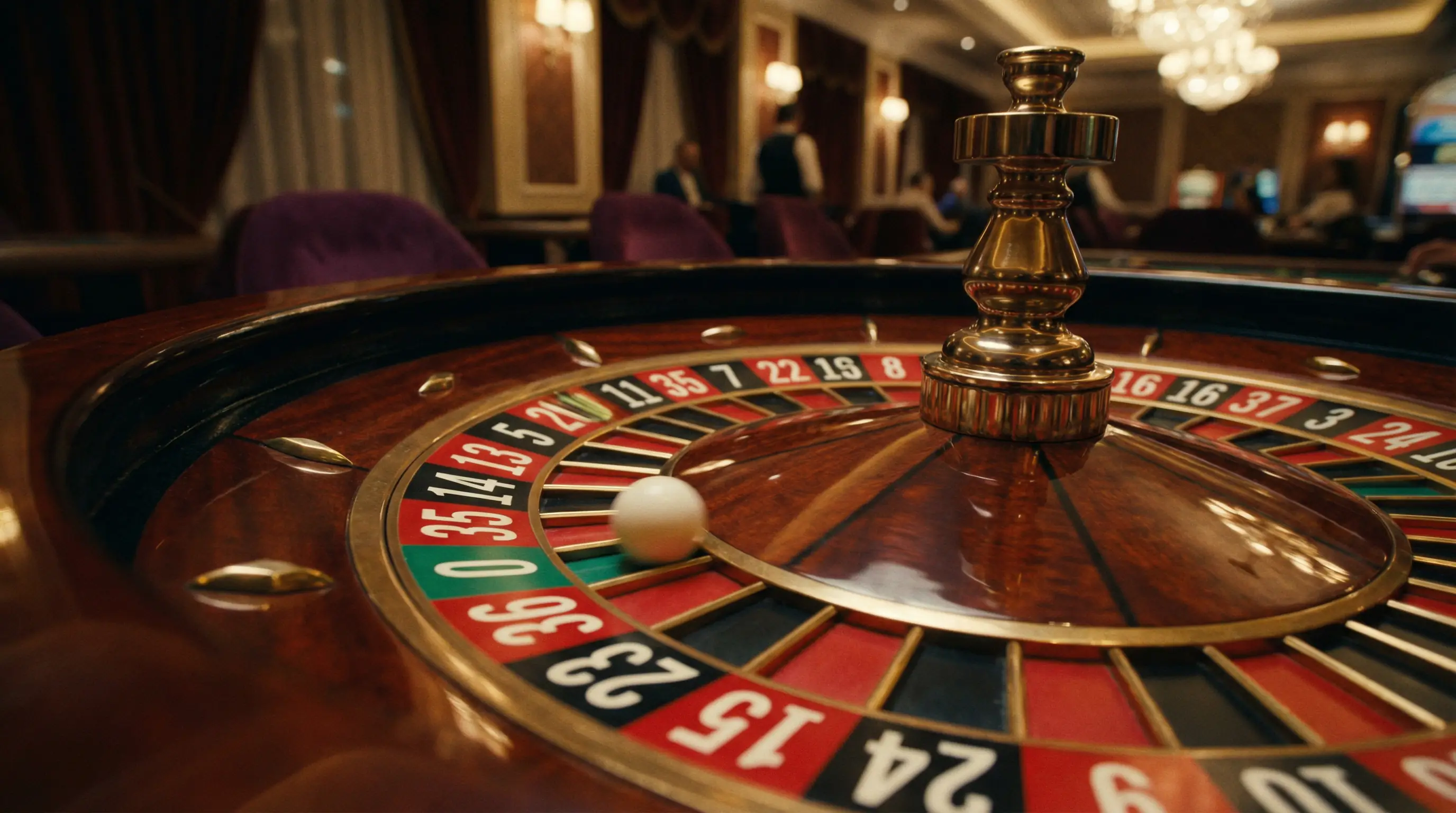
A Spinning Wheel and Fixed Odds
Roulette is the casino game that looks most like cinema imagines gambling. A spinning wheel, a bouncing ball, chips scattered across a numbered layout. The visual drama is real. The mathematics underneath are simpler than most players realise—and less forgiving than the elegant presentation suggests.
Unlike blackjack, roulette offers no decisions that affect the outcome. You place your bet, the wheel spins, the ball lands. Your only choice is which numbers or combinations to back and how much to stake. The house edge is fixed and unchangeable through skill or strategy.
This simplicity has appeal. There’s nothing to learn, no optimal play to master, no strategy charts to consult. You can sit down at a roulette table and understand the game within minutes. The barrier to entry is as low as any casino game offers.
What roulette does require is understanding which wheel you’re playing and what that means for your odds. The difference between European and American roulette—a single number on the wheel—nearly doubles the house edge. Players who don’t know this pay for their ignorance with every spin.
UK online casinos offer roulette in multiple formats: RNG games for solo play, live dealer tables for atmosphere, and variant rules that add twists to the classic formula. The core game remains constant across all of them. A wheel, a ball, and fixed probabilities that no betting system can overcome.
European vs American Wheels
The distinction between European and American roulette is the single most important thing any player should know. It determines whether you’re playing a relatively fair game or handing the casino nearly twice the edge.
European roulette uses a wheel with 37 pockets: numbers 1-36 plus a single zero. When the ball lands on zero, most bets lose. The house edge comes from this green pocket—it’s where the casino makes its money. On a European wheel, the house edge is 2.7%.
American roulette adds a second green pocket: the double zero. This increases the total pockets to 38 while keeping payouts identical. A straight-up bet still pays 35:1, but the odds of winning drop from 1 in 37 to 1 in 38. The house edge jumps to 5.26%. You’re paying almost twice as much for the same game.
The maths is unambiguous. Over time, European roulette returns more to players than American roulette. There is no scenario where choosing the American wheel makes mathematical sense. Any claimed advantage—atmosphere, tradition, whatever—costs you real money.
UK online casinos offer both variants. European roulette typically dominates, but American wheels appear often enough to trap inattentive players. Always check before you play. The wheel graphic shows the difference clearly: one zero versus two.
Some casinos offer French roulette, which uses the European wheel but adds rules like “la partage” or “en prison” that return half your even-money bet when zero hits. These rules reduce the house edge further, to around 1.35% on outside bets. French roulette is the best standard variant available—when you can find it.
Bets, Payouts and Probabilities
Roulette bets divide into two categories: inside bets on specific numbers and outside bets on broader groupings. The payouts vary but the house edge remains constant across almost all wagers on a given wheel.
Inside bets offer higher payouts with lower probabilities. A straight-up bet on a single number pays 35:1 but wins only 2.7% of the time on a European wheel. Split bets covering two numbers pay 17:1. Street bets on three numbers pay 11:1. Corner bets on four numbers pay 8:1. Six-line bets covering six numbers pay 5:1.
Outside bets provide better odds of winning but smaller payouts. Red or black, odd or even, high (19-36) or low (1-18)—these even-money bets pay 1:1 and win just under half the time. Dozen bets covering 12 numbers pay 2:1. Column bets, also covering 12 numbers, pay the same.
The house edge on European roulette is 2.7% for nearly every bet. The single exception is the five-number bet on American roulette (0, 00, 1, 2, 3), which carries a house edge of 7.89%—the worst bet on any roulette table. Never make this bet.
Players sometimes believe that outside bets are “safer” than inside bets. In terms of variance, they are—you’ll experience smaller swings betting red/black than betting single numbers. But the house edge is identical. Over time, you lose 2.7% of everything you wager regardless of which bets you choose.
Understanding this matters because it exposes betting systems for what they are. No combination of bets, no progression of stakes, no pattern of wagers changes the fundamental mathematics. The house edge applies to every chip you push across the layout.
Live Roulette and Game Variants
Live dealer roulette streams a real wheel spinning in a real studio, with a real croupier managing the game. The experience differs substantially from RNG roulette, even though the mathematics remain identical.
Evolution Gaming dominates live roulette at UK casinos. Their studios produce multiple variants: standard European tables, immersive roulette with dramatic camera angles, speed roulette with compressed betting windows, and lightning roulette with random multipliers on straight-up bets. Playtech and Pragmatic Play offer alternatives with their own production styles.
The social element distinguishes live play. Chat functions let you interact with dealers and other players. The pace feels different—you watch the ball actually spin rather than clicking and seeing an instant result. Some players find this more engaging; others find it slower than they’d like.
Lightning Roulette deserves specific mention because it changes the game’s mathematics. Random numbers receive multiplied payouts (up to 500:1) on each spin, but straight-up bets pay 29:1 instead of the standard 35:1 when no multiplier applies. The adjusted payouts maintain the house edge while adding volatility. You’re not getting better odds—you’re getting different variance.
Auto roulette runs without a human dealer, using mechanical wheels captured on camera. The game moves faster than dealer-operated tables. Some players prefer the pace; others miss the human interaction.
RNG roulette uses software to generate outcomes. Results appear instantly, allowing far more spins per hour than any live table. The games are audited to ensure fairness, but the experience lacks the tactile satisfaction of watching a physical wheel. For players who want speed and volume, RNG delivers. For those who want atmosphere, live tables exist.
Playing Without Illusions
Roulette attracts more betting systems than any other casino game. Martingale, Fibonacci, Labouchère, D’Alembert—players have been inventing and reinventing progression systems for centuries. None of them work.
The logic behind progressive betting seems sound: double your bet after each loss, and when you eventually win, you’ll recover everything plus a small profit. The problem is table limits and finite bankrolls. A losing streak of 10 spins at even-money bets—which happens more often than intuition suggests—requires a bet of over 1,000 units to continue the progression. Most players hit table maximums or run out of money first.
Pattern tracking is equally futile. Electronic displays at live roulette tables show recent results, inviting players to spot trends. The wheel has no memory. Twenty consecutive red results don’t make black more likely on spin twenty-one. Each spin is independent. The probability remains exactly the same regardless of what came before.
Sensible roulette play starts with accepting these realities. Choose European or French roulette—never American. Set a budget you can afford to lose. Treat the game as entertainment with a cost, not as an investment with expected returns.
Bankroll management matters for variance control. Outside bets produce steadier results; inside bets create bigger swings. Neither changes the long-term outcome, but they create different session experiences. Match your betting style to your bankroll and your tolerance for volatility.
When the money’s gone, stop. Chasing losses at roulette is particularly destructive because there’s no skill element to fall back on. You can’t play your way out of a hole. The wheel doesn’t care about your situation.
The Wheel Doesn’t Remember
Roulette’s appeal is straightforward: elegant simplicity with genuine tension. You don’t need to learn anything to play. You don’t need to make complex decisions. You place your chips, watch the wheel, and hope.
That simplicity comes at a cost. Without skill elements, you have no way to improve your results. The house edge is fixed. Every session, every bet, every spin extracts the same percentage in expectation. What you can control is which wheel you play and how much you risk.
The game endures because the experience delivers something that mathematics alone can’t capture. The visual drama of the spinning ball, the collective anticipation as it slows, the moment of resolution—these create genuine entertainment even when the outcome disappoints. Players have been paying for this entertainment since the 18th century.
Just don’t confuse entertainment with opportunity. Roulette offers no edges, no exploitable patterns, no systems that overcome the house advantage. The wheel doesn’t remember previous spins. It doesn’t owe you a win after a series of losses. It doesn’t care about your hunches or your lucky numbers.
Play for the experience, set limits that make sense, and accept the mathematics for what they are. Roulette is honest about its odds in a way that makes informed play straightforward: pick the right wheel, manage your bankroll, enjoy the spin. The rest is just physics and probability doing what they’ve always done.