The Game Where Decisions Matter
Blackjack occupies a unique position among casino games. Unlike slots, where outcomes are entirely random, blackjack gives players meaningful choices. Hit or stand. Double down or play safe. Split or keep the pair together. These decisions affect results in ways that basic probability can quantify.
This makes blackjack the thinking player’s casino game—though “thinking” comes with caveats. The optimal strategy has been mathematically solved. Computer simulations have determined the correct play for every possible hand against every dealer upcard. Following this strategy doesn’t guarantee wins, but it does minimise the house edge to a fraction of what most casino games extract.
At UK online casinos, blackjack comes in dozens of variants with subtle rule differences that affect the odds. Some favour the player; others tilt further toward the house. Understanding which is which separates informed play from gambling blind.
The game’s appeal lies in this combination of chance and agency. You can’t control which cards appear, but you can control how you respond to them. Play correctly and the house edge drops below 0.5%—among the lowest in any casino. Play incorrectly and that edge balloons. The maths rewards knowledge and punishes intuition.
Whether you’re playing RNG-based blackjack or sitting at a live dealer table, the strategic principles remain constant. The cards don’t care about the delivery mechanism. What matters is whether you know what to do when they land.
Rules and How Hands Play Out
Blackjack’s objective sounds simple: beat the dealer’s hand without exceeding 21. Cards 2-10 count at face value. Face cards (Jack, Queen, King) count as 10. Aces count as 1 or 11, whichever benefits the hand. A hand totalling over 21 busts and loses immediately.
Each round begins with two cards dealt to the player (face up) and two to the dealer (one face up, one hidden). The player acts first, choosing from several options. Hit means take another card. Stand means keep the current total. Double down means double the bet and receive exactly one more card. Split (when holding a pair) means separate the cards into two hands, each with its own bet.
After the player completes their decisions, the dealer reveals the hidden card and plays according to fixed rules—typically hitting on 16 or less and standing on 17 or more. The dealer has no choices; house rules dictate every action. This constraint is crucial: it means player strategy can be mathematically optimised against a predictable opponent.
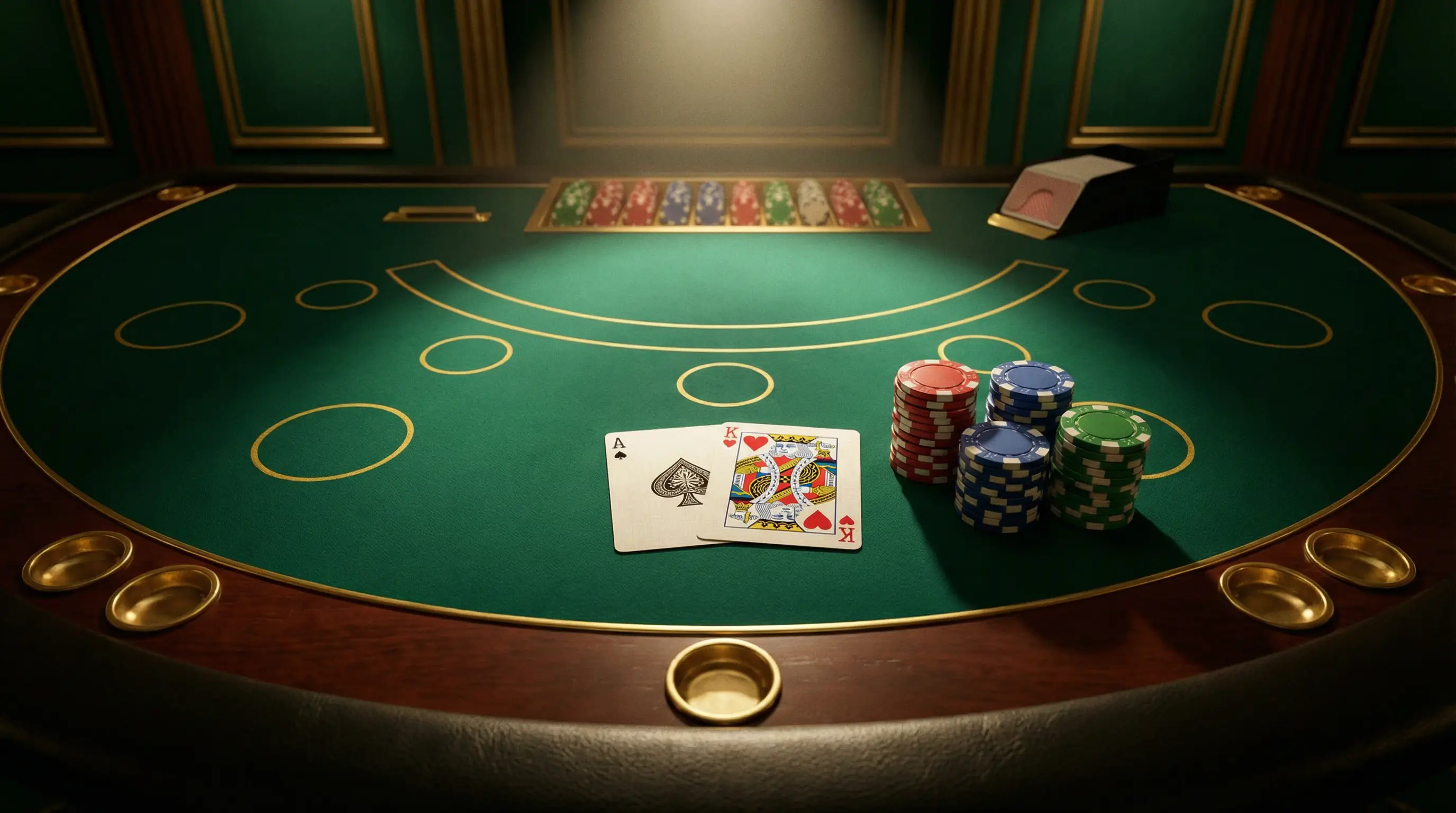
A natural blackjack—an Ace plus a 10-value card on the initial deal—typically pays 3:2, meaning a £10 bet returns £25. Some variants offer 6:5 payouts instead, which significantly worsens the player’s odds. Checking the paytable before playing isn’t paranoia; it’s due diligence.
Side bets appear in many modern variants: insurance against dealer blackjack, perfect pairs, 21+3 poker-style bets. These carry substantially higher house edges than the main game. They add excitement for some players but cost money in expectation. The core game remains the better mathematical proposition.
Online versions use random number generators to simulate shuffled decks. Live dealer games stream real cards from physical tables. The rules and odds apply equally to both formats.
Basic Strategy and the House Edge
Basic strategy is the mathematically optimal way to play every blackjack hand. It’s not a betting system or a secret technique—it’s a chart showing the correct action for every combination of player cards and dealer upcard. Following it perfectly minimises the house edge to around 0.5% in standard games.
The strategy isn’t intuitive. Standing on 12 against a dealer’s 4 feels wrong when you could improve your hand. Hitting on 16 against a 10 feels suicidal. But the maths has been computed across millions of simulated hands. The “wrong” feeling plays are often the correct ones.
Key principles emerge from the chart. Always split Aces and 8s. Never split 10s or 5s. Double down on 11 against everything except dealer Ace. Stand on hard 17 or higher. Hit on soft 17 (Ace-6). These rules have exceptions based on specific situations, but they capture the strategic core.
Without basic strategy, average players give the house 2% or more edge—four times worse than optimal play. The difference compounds over time. A recreational player making intuition-based decisions loses money faster than one following the chart, even though both face the same cards.
Learning basic strategy takes effort. Memorising every cell of a chart isn’t trivial. But unlike slots or roulette, the effort pays off in measurably better results. Online play offers an advantage here: no one stops you consulting a chart while the software waits for your decision.
Card counting—tracking the ratio of high to low cards remaining in the shoe—can theoretically shift the edge to the player. Online blackjack defeats this by shuffling after every hand or using large virtual shoes. Live dealer games reshuffle frequently enough to make counting impractical. In the UK regulated market, basic strategy is the realistic ceiling for player skill.
Variants and Where to Play
Not all blackjack is created equal. Rule variations between games affect the house edge, sometimes dramatically. Knowing what to look for helps you choose tables that offer better odds.
The number of decks matters. Single-deck blackjack carries a lower house edge than eight-deck games, all else being equal. Most online blackjack uses six or eight virtual decks, but single and double-deck variants exist. Check before playing.
Dealer rules on soft 17 affect the odds. When the dealer must stand on soft 17 (Ace-6), the house edge drops by about 0.2% compared to rules requiring the dealer to hit. This single rule difference can be the margin between a favourable and unfavourable game.
Doubling restrictions matter too. The best games allow doubling on any two cards. Some restrict doubling to totals of 9, 10, or 11 only. Others prohibit doubling after splits. Each restriction costs the player a fraction of a percent.
Blackjack payout is critical. Classic 3:2 payout on natural blackjack is standard. Games offering 6:5 increase the house edge by roughly 1.4%—an enormous difference that dwarfs most other rule considerations. Avoid 6:5 games unless you genuinely don’t care about the odds.
European blackjack typically deals the dealer’s second card only after the player completes their actions. This affects strategy slightly and increases the house edge marginally. Atlantic City rules, Spanish 21, Blackjack Switch, and other variants each carry their own quirks and optimal strategies.
Live dealer blackjack at UK casinos typically follows European or Vegas rules. Tables vary in minimum and maximum bets, pace of play, and available side bets. Evolution Gaming dominates the live blackjack market, with Playtech offering alternatives. The underlying game remains the same; the experience and stakes differ.
Bankroll and Session Management
Blackjack’s low house edge doesn’t mean you can’t lose money. Short-term variance guarantees sessions where correct play still produces losses. Managing your bankroll recognises this reality.
The standard advice applies: only gamble what you can afford to lose. Set a session budget before you start. When it’s gone, walk away. The temptation to chase losses is real, especially in a game where you know you’re playing correctly. Resist it. Variance doesn’t care about your strategy.
Bet sizing should match your bankroll. Playing £50 hands with a £200 budget means four losing hands end your session. Playing £5 hands with the same budget gives you breathing room for the natural swings. Most bankroll guidelines suggest having 50-100 betting units available for a session—meaning £5 bets for a £250-500 budget.
Progressive betting systems—Martingale, Fibonacci, and their variations—promise to overcome the house edge through bet sizing. They don’t work. The maths has been analysed exhaustively. These systems don’t change the underlying odds; they just rearrange when you win and lose. Often they produce small wins followed by catastrophic losses when you hit table limits or deplete your bankroll.
Time limits matter as much as money limits. Extended play produces fatigue, which leads to strategy mistakes. A four-hour blackjack session demands sustained concentration; errors compound into real money lost. Taking breaks maintains the quality of your decisions.
Use the responsible gambling tools UK casinos provide. Deposit limits prevent impulsive top-ups. Session reminders break concentration spirals. These aren’t admissions of weakness; they’re rational constraints that experienced players often appreciate.
When Skill Meets Chance
Blackjack rewards study in ways that pure chance games cannot. Learn basic strategy and you’ll play with an edge under 0.5%—better than almost any other casino offering. Ignore strategy and you’ll pay several times more to the house. The difference is real and quantifiable.
This doesn’t make blackjack a reliable income source. Even perfect strategy faces a house edge. Over enough hands, the casino wins. The skill component reduces losses and extends play; it doesn’t transform gambling into investment. Anyone claiming otherwise is selling something.
What blackjack offers is engagement. Every hand presents a decision point where knowledge matters. That involvement creates satisfaction that random outcomes alone can’t match. Winning because you made the right play feels different from winning because the RNG favoured you.
UK online casinos offer blackjack in multiple formats: RNG games for solo practice, live dealer tables for social atmosphere, variant rules for those seeking novelty. The core game remains consistent across all of them. Master basic strategy once and it applies everywhere.
The game sits at the intersection of skill and chance, offering meaningful choices within a framework that still favours the house. That combination has attracted players for centuries. It’ll continue attracting them because the appeal is genuine: a fair game, transparent odds, and decisions that actually matter. In the casino world, that’s worth something.