

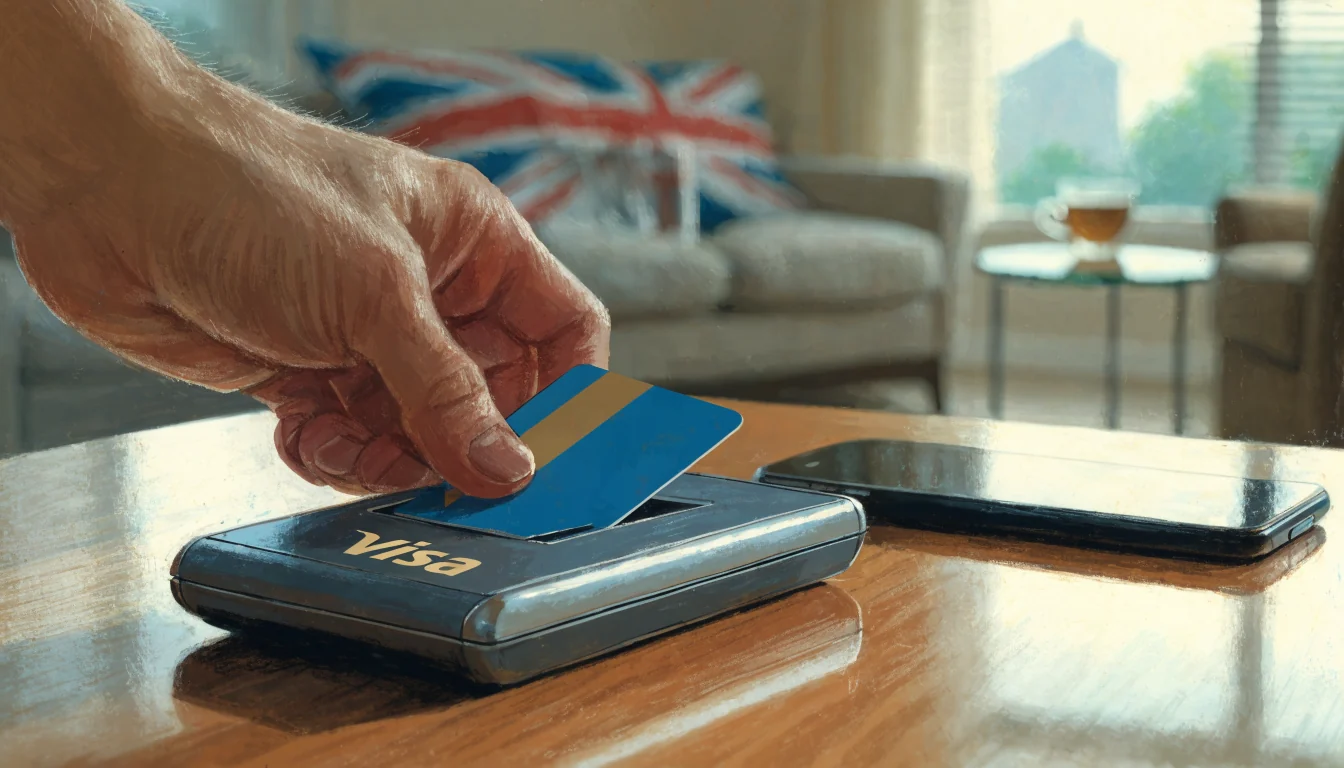
Debit cards draw on a current-account balance, while card support, payout routes, limits and fees can vary by casino.
Can You Use a Debit Card at a UK Online Casino?
Yes. Debit cards are a standard way to fund an account at many UK online casinos, and Visa and Mastercard are the names you will most often see in the cashier. If your card is supported by the casino and issued for your use, you can generally select it, enter the requested details and make a gambling deposit from your bank balance.
That answers the basic question: you can use a debit card for online gambling in the UK. The payment comes from money already held in your current account, rather than from a credit facility. You should still use a remote gambling licensee serving the British market and complete the required age checks before depositing.
The position is different for credit cards. UK rules prohibit credit-card payments for gambling at UK-licensed casinos. This ban took effect on 14 April 2020 and has not been relaxed. It covers direct credit-card deposits, so a credit card should not be treated as an alternative simply because the casino’s cashier displays several card brands.
A similar point applies when a payment service is funded by credit. UK gambling rules also prevent wallet payments where the wallet permits credit-card funds to be used for gambling. In practical terms, the money’s route matters, not just the logo shown at the final payment screen.
Debit cards are therefore the straightforward card option, but “accepted” does not mean every card works at every casino. A particular cashier may support Visa or Mastercard while declining a specific card product or transaction. Your account and card must also belong to you; using matching ownership details avoids basic payment confusion.
UK Casino Sites Accepting EcoPayz and Payz
I would treat the debit card as the starting point, not the whole payment decision. The cashier is where you confirm what that casino currently supports. That check matters.
What to Check Before You Deposit by Card
A casino may mention Visa and Mastercard among its payment options, but that does not settle whether your own debit card can be used there today. The practical check happens in the cashier, after you have opened an account and completed the required account details.
That distinction matters. A payment logo on an information page is only a sign that the casino has offered that card network at some point. The cashier is where you can see the options attached to your account, location and account currency. I treat the cashier as the useful answer, rather than relying on a general payment-method list.
Start with the cashier, not the advert
Sign in and open the deposit area. Look for the card section and check which branded options are actually displayed. Visa and Mastercard are the relevant names to look for, but do not assume that seeing one of them elsewhere on the site means your card is eligible.
Before entering any details, check:
- whether Visa, Mastercard or both are shown;
- whether the option is available for your account;
- whether the cashier identifies the card route as a debit-card deposit;
- which currency is attached to the account;
- whether the payment screen remains available after you select the card method.
A specialist review may list Visa and Mastercard for a casino, but current availability and card-product eligibility still need to be confirmed in the operator’s own cashier. That small extra step is worth taking. Payment pages change, and a review cannot see the options currently presented to your account.
Do not use a credit-card payment for gambling. UK-licensed casinos cannot accept credit-card payments for gambling, and a card that looks similar to a debit card should not be treated as eligible until you know what product it is. If you are unsure whether your card is debit, prepaid or another type, check with the card issuer before attempting the payment.
Check the card product, not just the brand
Visa and Mastercard are networks, not guarantees that every card carrying the logo will work in the same way. The important question is not simply, “Does this casino show Visa?” It is, “Does this casino accept this type of card for this account?”
Read the wording on the cashier and payment screen carefully. If the operator gives a card-product description, make sure it matches your card. Do not substitute another card merely because it carries the same brand. A Visa debit card and a different Visa product may not be treated identically by the payment system.
The name and account details deserve the same attention. Use a card belonging to the same customer named on the casino account. Matching ownership information reduces the chance that a basic detail becomes an avoidable obstacle during a transaction. It is the cleanest arrangement: your casino account, your card, and information that agrees across both.
DO
- Use a card that belongs to you
- Match ownership details with the casino account
- Check the cashier for supported card brands and currency
DON’T
- Use a credit card for gambling
- Use a card belonging to someone else
- Rely on general lists instead of the cashier
I would also avoid using someone else’s card, even with their permission. Permission between two people does not necessarily make the payment acceptable to the casino. If the account holder and cardholder are different, the operator may need to examine the ownership position rather than processing the payment without questions.
Confirm the account currency
The cashier should show, or allow you to identify, the currency connected to the casino account. For a UK account, GBP is the relevant currency to look for, but confirm it before making the first transaction. Seeing a pound symbol somewhere on the website is not enough if the account itself is set up differently.
Currency affects what you see at the payment stage and how the transaction is recorded. If the casino account is not in GBP, your card issuer or another payment party may handle a conversion. That can make the amount leaving your bank account differ from the amount displayed in the casino balance.
So, before entering the card details, check:
- the currency displayed in the account or cashier;
- the currency shown beside the deposit amount;
- whether the payment page presents the same currency;
- whether your card account uses that currency.
A specialist review may describe GBP as supported, but the account currency should still be checked inside the casino before the first payment. This is not difficult, and it prevents a basic setting from being discovered only after money has moved.
Make sure the account is ready
The cashier is also a useful place to spot unfinished account requirements. Check that your personal information is complete and consistent before attempting a deposit. The account holder’s name should correspond with the name attached to the debit card, and the rest of the information should not contain avoidable discrepancies.
UK remote gambling operators verify a customer’s age before allowing funds to be deposited into a gambling account. That means an account may need to pass the relevant checks before the deposit function is fully available. If the cashier directs you to complete an account step, do that first rather than repeatedly trying the card.
This is where many payment problems become needlessly confusing. A card can be suitable in principle, yet the account may not be ready for deposits. I check the account status, the payment method and the currency separately. Treating them as three different checks makes the cashier easier to read.
Read the payment screen before confirming
Once the card option is selected, pause on the final payment screen. Check that the method still says debit card, that the currency is correct and that the account information is yours. Review the displayed amount and any instruction attached to the payment method before confirming.
Do not assume that an option visible in the cashier is available under every account condition. The screen shown after selection is the more relevant stage. If the method disappears, changes description or directs you to another route, follow the current instructions rather than relying on an earlier page.
A casino’s general payment page can be useful for orientation, but the cashier is the place to confirm the live combination of:
- your account;
- your card product;
- the available card network;
- the account currency;
- the ownership details connected with the payment.
That combination is more important than a long list of logos.
Keep the first check simple
For a straightforward card deposit, I would not begin by comparing every payment icon on the website. I would sign in, open the cashier, find Visa or Mastercard, confirm that the card type is eligible, verify that the account is in GBP and check that the card belongs to the same customer.
If all of those details line up, the payment route is at least compatible with the account as presented by the cashier. If one does not, stop there and resolve that detail instead of trying random cards or changing account information. Payment systems are poor places for guesswork.
One final point: a card being accepted by the cashier does not turn an account belonging to someone else into your account. Keep the ownership details consistent from the beginning. It is a modest bit of housekeeping, but it removes one of the most avoidable sources of friction around a payment.
Verification Process
The cashier is the most reliable source to confirm current payment options and account status.
How Debit Card Deposits and Withdrawals Work
Using a debit card at a UK online casino is generally a two-part process: money going in and money coming back out. Those transactions may appear to belong to the same payment method, but they are not mirror images. A card deposit can be approved almost immediately, while a withdrawal has to pass through the casino’s own checks before the money is released.
That difference is the main thing to understand when using a debit card online casino. Seeing a card deposit credited to your balance does not mean that a later payout will move through the same system at the same speed. The cashier may accept the deposit straight away, yet the withdrawal can remain pending while the remote gambling licensee checks the account and confirms where the funds should be sent.
What happens when you make a debit card deposit?
You begin by choosing the card option in the casino cashier and entering the requested payment details. The casino then sends the transaction for authorisation. If the card and account pass the relevant checks, the deposit is added to your casino balance.
For the player, this can feel almost instant. A specialist review describes the familiar contrast clearly: a card deposit may reach the gaming balance immediately, whereas the payout can take several business days. That is not a contradiction. The deposit is a request to add funds; the withdrawal is a request to remove them and deliver them through an approved route.
Your bank or card issuer remains involved in the first transaction. A successful authorisation means the payment has been accepted for processing, not that every later transaction will be treated automatically. The casino still has to deal with a separate withdrawal request under its payment and verification procedures.
I find it useful to think of the cashier as having two separate doors:
- Deposit: money is authorised and credited to the casino account.
- Withdrawal: the casino reviews the request, confirms the permitted destination and sends the money for delivery.
The first door is often quick. The second has paperwork behind it.
Requesting a withdrawal to a debit card
Once you request a payout, the casino records the amount and checks the transaction against your account. The card used for the deposit may then be selected as the return route, provided the cashier supports that arrangement. This is why an online casino withdrawal to a debit card is not always handled like a fresh card payment.
The withdrawal may first show as pending. That status means the casino has received the request but has not yet completed its internal approval. The time involved can include account checks, payment review and any KYC work that still needs to be completed. A specialist review notes that a first withdrawal can take longer while verification is being finished. Treat that as a description of a reported process, not as a fixed timetable for every debit card casino online.
After approval, the casino sends the payout towards the relevant card or another permitted payment destination. The remaining delivery time is then separate from the casino’s internal review. In practical terms, “withdrawal time” can cover more than one stage:
- You submit the request in the cashier.
- The casino places it into its approval process.
- Any outstanding verification is dealt with.
- The approved payment is sent through the chosen route.
- The card issuer or payment system completes the delivery.
The cashier may therefore show an approved withdrawal before the money is visible in your bank account. Conversely, a request marked pending has not reached the final delivery stage.
Why the payout may go back to the original card
The return route is not simply a matter of choosing whichever destination looks most convenient. UK anti-money laundering controls generally link a payout to the payment source used for the deposit. In other words, if you fund an account with a Visa debit card, the casino may direct the relevant return towards that same card rather than sending it somewhere unrelated.
This approach also acts as an anti-fraud safeguard. Returning funds to the original source helps the casino connect the incoming and outgoing transactions to the same customer and payment instrument. It is part of the closed-loop logic used to reduce uncertainty around ownership of the money.
That is why the withdrawal screen may offer fewer choices than the deposit screen. A casino might display several ways to add funds, but the payout route can be restricted by the source of those funds and by the casino’s payment rules. A deposit method being visible in the cashier does not, by itself, mean that it can receive withdrawals.
Anti-Money Laundering
UK regulations often require payouts to be returned to the original payment source used for the deposit.
If the original card cannot accept the return, the casino may ask for an alternative method. The replacement route can require additional verification because the operator must establish that the new destination belongs to you and is suitable for the payout. This is not an invitation to move money between unrelated accounts. Keeping your account details and payment details aligned is the cleaner approach.
Why a debit card withdrawal can take longer
A card deposit is an authorisation to take money from the card and credit the casino balance. A withdrawal reverses the direction and requires the casino to release money under its controls. Those are different risk decisions.
The casino may need to confirm that the account belongs to an eligible customer, review the payment history and complete KYC before approving the first payout. The approval stage is especially important when the operator has not yet finished checking the account. That is why a first withdrawal may take longer than a later request, according to a specialist review.
There is also a difference between processing and delivery. Processing is the casino’s work: assessing and approving the request. Delivery is what happens after the payment has been sent to the card or associated banking system. A casino can complete its part while the payout is still moving through the payment chain.
A reported card-payment pattern is therefore straightforward: the deposit appears quickly, but the payout may take several business days. The exact experience depends on the casino’s internal approval and the state of your verification. It is safer to read the cashier’s status literally rather than assuming that a fast deposit promises a fast withdrawal.
What to expect from the cashier
The cashier normally gives you the clearest view of the transaction’s position. When depositing, it should show whether the card option is available and whether the payment has been accepted. When withdrawing, it should identify the available destination and display the request’s status.
Pay attention to the wording used for the withdrawal:
- Requested means the casino has received your instruction.
- Pending indicates that approval has not been completed.
- Approved means the casino has accepted the payout for sending.
- Completed indicates that the operator has finished its payment action, although the funds may still need to appear on the card account.
These labels describe the usual shape of a cashier process rather than a promise that every operator uses identical terms. If the wording is unclear, the casino’s payment help page or support team should explain what its status means.
You should also keep the confirmation for the deposit and withdrawal. It gives you the transaction reference, the selected card route and the amount involved. If the money does not appear when expected, those details make it easier to ask the casino what stage has been reached. The same record can help separate an operator-side delay from a card issuer or payment-system delay.
When the casino asks for more verification
A request for identity or payment verification is not necessarily a problem with the card. It can be part of the casino’s normal KYC and anti-money laundering controls, particularly when the first withdrawal has not yet been processed.
The operator may need to confirm that the name on the gambling account matches the person using the debit card and that the payout is returning to the rightful source. If the casino proposes a different destination because the original card cannot receive the money, further checks may follow. Alternative routes carry more ownership questions, so the operator may ask for evidence before releasing the funds.
This is also why using someone else’s card creates avoidable difficulty. The cleanest transaction trail is one where the account holder, the debit card and the payout recipient are the same customer. When those details line up, there is less basic ownership uncertainty for the casino to resolve.
Casinos That Accept Wirecard in the UK: How to Check
Do not treat a pending first withdrawal as proof that the card has failed. The payment may simply be waiting for the casino’s approval process or for KYC to be completed. If the cashier requests documents or confirmation, provide what is requested through the operator’s secure process rather than opening another payment route and making the transaction trail harder to follow.
Deposit speed is not withdrawal speed
The most common mistake is to judge a debit card casino online solely by how quickly the deposit appears. That tests only the incoming side of the cashier. The outgoing side has its own approval and delivery stages.
A card deposit can be instant, yet the corresponding payout can take several business days. A specialist review makes this distinction between the two directions, and it is a useful expectation to carry into any online casino with debit card deposit. The casino must approve the withdrawal, verify the account where necessary and return the funds through a permitted source. The bank or card system then has its own part to complete.
So, when using a Visa debit card online casino, check the status of the withdrawal rather than repeatedly submitting new requests. A second request will not necessarily speed up the first and may create additional confusion in the payment record. The sensible sequence is simple: use the cashier, follow the stated verification process, retain the confirmation and allow the approved transaction to complete its route.
Fast in, slower out. That is the practical shape of card payments.
Choosing a Payment Route for Deposits and Payouts
A debit card is a straightforward choice for casino payments in the UK. Visa and Mastercard cards are familiar, widely recognised and connected directly to your bank account. That makes them easy to understand: you select the card in the cashier, enter the requested details, and the casino can match the payment route to your account.
PayPal
An e-wallet that provides a separate payment account and can offer quicker withdrawal speeds.
Open Banking
Connects your bank account directly to the casino for instant deposits and fast withdrawals.
Skrill / Neteller
Established e-wallets that are common at many UK-facing casino sites.
The important comparison is not simply which method accepts a deposit. You also need to know how winnings will be paid out. A route that works for adding funds but is not available for withdrawals can leave you waiting while the casino arranges another way to return the money. I check both sides of the cashier before settling on a method. It is a small habit, but it avoids an irritating surprise later.
Debit cards: familiar, but not automatically the quickest
Debit cards suit players who want to use an existing bank account without opening a separate wallet. They are also convenient when you want your casino account and payment history to remain easy to follow in one place. A Visa debit card or Mastercard debit card may appear as a separate option in a casino cashier, even though the underlying process is similar from your point of view.
For withdrawals, however, the card route depends on the casino’s payout arrangements and the particular card setup. Some debit cards are linked to systems designed for quicker payouts. A specialist review describes debit cards connected to such systems, alongside PayPal and open banking, as being among the quicker withdrawal choices. That is useful context, not a promise for every casino or every card.
The practical lesson is simple: do not assume that a rapid card deposit means a rapid card payout. The two transactions can follow different internal processes. If withdrawal speed matters to you, look for clear information in the cashier and payment terms about whether the same card route handles withdrawals.
PayPal and other e-wallets
PayPal can appeal if you would rather not enter card details directly at the casino. It gives you a separate payment account and may make the payment screen feel more familiar, particularly if you already use PayPal elsewhere. It is also identified by a specialist review as one of the quicker withdrawal routes, although the actual result still depends on the casino’s process and the status of your account.
Casinos That Accept Bitcoin in the UK: What to Check
E-wallets can be useful when you want to keep gambling payments apart from day-to-day card spending. The trade-off is that you now have another account to maintain, and the casino may need to confirm that the wallet belongs to you. That is why your wallet details, casino account information and identity documents should all tell the same story.
A wallet must also be suitable for gambling payments under UK rules. Remote gambling operators cannot accept a wallet payment where the wallet permits credit-card funds to be used for gambling. In other words, choosing an e-wallet does not create a way around the restriction on credit-card payments for gambling. Use funds held through an acceptable route, and check the cashier’s terms rather than assuming every wallet arrangement is treated alike.
Open banking and bank transfers
Open banking connects the casino payment screen with your bank, allowing you to approve a transfer through your banking service. Bank transfer payments use your bank account more directly and can suit players who prefer not to use a card or an e-wallet.
A specialist review reports that open banking and bank transfers can produce instant deposits and fast withdrawals at many sites. The wording matters: this is a route-dependent feature, not a universal result. The casino, the banking service and the account setup all affect what happens. Check the available withdrawal option before depositing, because a bank transfer shown for adding funds does not by itself confirm that it can be used to receive winnings.
Bank transfer delivery can also be affected by cut-off times, weekends and currency conversion, as noted in a specialist review. That makes the route less predictable than the word “instant” on a deposit button might suggest. Depositing and withdrawing are separate stages, and a bank may handle the return payment differently from the initial authorisation.
Open banking can be a sensible middle ground by using a verified bank account and supporting quick payouts.
Open banking can nevertheless be a sensible middle ground. You use a verified bank account, the approval takes place through your banking service, and the route may support a quick payout where the casino has enabled it. I would still read the cashier wording carefully before choosing it.
Skrill, Neteller and similar wallets
Skrill and Neteller are established e-wallet names that appear at some UK-facing casino sites. A specialist review describes Skrill as one of the more common deposit choices at UK-friendly casino sites in 2026. That tells you the method remains relevant, but not that it will be available at every casino or that it will be included in every promotion.
The same type of review says Skrill and Neteller are often left out of promotions. Treat that as a condition to check, not as a reason to reject the method. If a welcome offer or another promotion matters to you, read its payment-method exclusions before funding the account. Payment convenience and promotional eligibility are separate questions.
Casinos That Accept iDEAL in the UK: Payment Guide
For either wallet, confirm both directions of payment. You want to see whether the wallet is accepted for deposits and whether it can receive withdrawals. Also make sure the wallet account is held in your name. A mismatch between the casino profile and the payment account can create avoidable checks at precisely the point when you want your money returned.
Prepaid and less common routes
Paysafecard is a deposit-only prepaid voucher. It can therefore be useful for adding funds where the cashier accepts it, but it is not a complete route for deposits and payouts. If you choose it, understand from the start that a withdrawal will need a different verified method.
Jeton is another name that remains available at a handful of UK online casinos in 2026, according to a specialist review. Its limited presence means you should treat it as a site-specific option rather than a dependable choice across the market. Check the cashier for deposit and withdrawal support, then confirm the account ownership requirements.
Some UK Gambling Commission-licensed casinos also accept Apple Pay for deposits. That may be convenient if your card is already connected to Apple Pay, but deposit availability alone does not establish that the same route can receive a payout. Check the withdrawal menu before relying on it as your main payment method.
Casino Payments: UK Deposit and Withdrawal Methods
Why one named account is usually cleaner
The cleanest arrangement is often one named account used consistently for both sides of the transaction. That might be your own debit-card account, your own PayPal account, a personal e-wallet or a bank account connected through open banking. The point is not the brand. The point is consistent ownership.
Using someone else’s card or wallet can raise questions even when the deposit appears to go through. A casino may need to establish who supplied the funds and who is entitled to receive a withdrawal. Keeping your account name, payment details and identity information aligned reduces the chance that basic ownership checks create unnecessary friction.
This also makes your payment history easier to follow. You can see which route funded the account, which route the cashier offers for the return payment and whether the casino has introduced an extra verification step. Mixing several methods can be workable, but it gives the cashier more relationships to reconcile. My own rule is dull but reliable: one personal route, used consistently, unless the casino specifically directs the payout elsewhere.
A practical comparison
| Route | Main advantage | What to confirm |
|---|---|---|
| Debit card | Familiar access to your bank account | Whether your card supports withdrawals and any faster payout system |
| PayPal | Separate payment account and potential withdrawal speed | Whether it is eligible for the relevant promotion and belongs to you |
| Open banking | Direct bank approval and possible quick movement of funds | Whether withdrawals are enabled and how the bank handles delivery |
| Bank transfer | Direct use of a verified bank account | Whether the cashier supports both directions and how timing is affected |
| Skrill or Neteller | E-wallet alternative to paying by card | Withdrawal availability, ownership checks and promotional exclusions |
| Paysafecard | Prepaid deposit route | It is deposit-only, so choose a separate payout method |
| Apple Pay | Card-linked deposit option at some licensed casinos | Whether it is available for withdrawals, not just deposits |
| Jeton | An additional wallet option at a limited number of sites | Current cashier availability and support for payouts |
There is no single best debit-card casino payment route for every player. A debit card may be the most familiar, PayPal or an e-wallet may better separate casino payments from your bank card, and open banking or a bank transfer may suit someone looking for a direct bank-based route. The sensible choice is the one that supports both deposits and withdrawals, uses an account in your name and matches the casino’s current cashier options.
Fast is useful. Predictable is better.
Check the Deposit Minimum, Limits and Your Spending Controls
A debit card deposit is not governed by one universal minimum across every UK casino. A specialist review places the usual starting point at £10–£20, with the exact figure depending on the payment method selected. Treat that as a guide rather than a promise: the cashier is where the amount for your account is actually shown.
That distinction matters when you are comparing a debit card casino deposit with another route. A site may advertise a low entry amount, while the cashier applies a different minimum to the method you choose. The amount can also be displayed before you complete the payment, so there is little reason to guess or continue blindly. If the minimum is higher than you intended to spend, stop there rather than treating it as a small obstacle.
Check the limit before entering an amount
The minimum is only one side of the picture. Casinos also set maximum deposit limits, and these can apply to a single transaction, a day or a month. According to a specialist review, those ceilings vary with both the payment method and the status of the account. In practice, the figure available to a new customer may not be the same as the figure shown after the account has passed further checks.
Look for the limit information in the cashier or in the account’s safer-gambling area. It should be clear whether you are looking at:
- the largest amount accepted in one deposit;
- the total allowed over a day;
- the total allowed over a month;
- a limit you have chosen yourself; or
- a restriction applied by the operator.
These are easy to muddle, especially when a cashier shows a transaction limit beside a separate account control. A failed deposit does not necessarily mean the card or account is unusable; the amount may simply exceed the relevant ceiling. I check the wording before trying again. Repeating the same rejected amount is not a strategy.
Your account status can also affect what is available. A remote gambling licensee may apply different maximums while account checks are still being completed. That is one reason not to plan a payment around a headline limit shown elsewhere. Use the figure attached to your own account and current cashier session.
Set a boundary before the first deposit
UK rules put a financial-limit prompt at the start of the customer journey. Before a new customer makes the first deposit, the remote gambling licensee must ask them to set a limit. The account must also include accessible controls for managing financial limits later.
Financial Limits
Set a personal spending boundary that reflects what you can genuinely afford before making your first deposit.
This is more than a pop-up to dismiss. Choose a boundary you can keep without borrowing, stretching bills or relying on a future win. The useful control is the one that reflects what you can genuinely afford, not the largest figure the account will accept. A high operator maximum is not a sensible personal budget.
Take a moment to read what the control covers. Depending on the account interface, it may refer to deposits over a stated period, while the cashier may separately show the maximum allowed for one card transaction. Those two figures serve different purposes. One is your own spending boundary; the other is a payment or account restriction. Both can stop a deposit, but only one is chosen as your personal control.
If you later want to tighten the limit, do so through the account settings rather than waiting until the next deposit. Keep the control easy to find. The rules require account-level access to these tools, so you should not have to search through unrelated promotional pages to locate them.
Keep the figures practical
A sensible check before paying looks like this:
- Read the minimum shown for the selected deposit route.
- Confirm the maximum for the individual transaction.
- Check whether daily or monthly deposit ceilings also apply.
- Review the financial limit already attached to the account.
- Set or reduce your personal boundary before depositing if the current setting is too high.
- Enter only an amount that fits within that boundary and your available budget.
This approach separates affordability from technical approval. A transaction can be below the casino’s maximum and still be more than you should deposit. Conversely, a modest amount can be refused because it falls below the method’s minimum or above a restriction on the account. Neither result tells you what you can afford.
The safest habit is to decide your budget away from the excitement of the cashier, then use the account control to support that decision. If the minimum itself pushes you beyond that budget, the sensible answer is not to find a way around the control. Leave the deposit.
What happens when a limit blocks payment?
A limit may cause the cashier to reject the deposit, prevent the amount from being entered or display a message asking you to choose a smaller figure. Check whether the issue concerns the single transaction, the account’s rolling allowance or your own financial setting. The wording should point you towards the relevant part of the account.
Do not assume that trying a different amount repeatedly will change the underlying restriction. Nor should you increase a personal limit simply to make one deposit go through. If the limit was set deliberately, it is doing its job.
For anyone looking at the best UK casinos for debit card payments, deposit size should therefore be part of the comparison, but not the whole decision. A low advertised minimum is useful only if the account presents the limits clearly and gives you workable spending controls. I would rather see a plain cashier with understandable boundaries than a tempting entry figure surrounded by confusing restrictions.
Casinos That Accept Instadebit in the UK: What to Check
Fees, Currency Conversion and the Cost of Paying
The amount shown at the cashier is not always the full cost of a payment. A casino may charge its own fee, while the payment provider, card issuer or bank can add another. Network fees may also apply, depending on the route used. These costs can be separate, so a payment that appears fee-free at the casino may still cost more when it reaches your account.
Currency conversion deserves particular attention. If your casino balance and payment account use different currencies, the exchange rate may include a spread: the difference between the underlying rate and the rate applied to your transaction. A specialist review points out that this spread can cost more than a clearly displayed flat fee. In other words, “no fee” is not the same as “no cost”. Dry, but important.
For a fair comparison between debit card casino options, look at the complete transaction cost rather than one line in the cashier. Check whether the casino adds a charge, whether your provider or bank applies its own fee, and whether the payment is converted. Compare those details for the actual amount you intend to deposit or withdraw, because the cheapest-looking route is not automatically the cheapest once currency conversion and network costs are included. There is no single lowest-fee payment method for every transaction.
Can I deposit in GBP?
Yes, GBP is supported. Check your account currency and the currency shown in the cashier before depositing to avoid conversion.
Which method has the lowest fees?
There is no universally lowest-fee method. Compare the casino’s charges, provider and bank fees, currency conversion spread, and any network costs for your transaction.
Which payment methods are accepted in Great Britain?
UK casinos commonly offer Visa and Mastercard, bank transfers, and e-wallets such as PayPal, Skrill, and Neteller; some also accept Apple Pay, Paysafecard, or Jeton. Check the cashier for the options available to your account.
Is Skrill available?
Yes, Skrill is available at some UK-friendly casino sites and is a common deposit option. It may be excluded from promotions.
What is the fastest withdrawal method for UK casinos?
PayPal, open banking services, and debit cards linked to fast payout systems are generally among the quickest. The casino’s approval process and your verification status also affect how soon you receive funds.