

What Betting Odds Actually Represent
Betting odds serve two functions simultaneously: they tell you how much you’ll win if your bet succeeds, and they reflect the bookmaker’s assessment of how likely that outcome is. The first function is straightforward arithmetic. The second requires understanding that odds are opinions expressed as numbers — opinions calibrated to ensure the bookmaker profits regardless of results.
Every set of odds implies a probability. When a bookmaker prices a football team at 2/1, they’re suggesting that outcome has roughly a 33% chance of occurring. When odds shorten to 1/2, the implied probability jumps to around 67%. These probabilities don’t perfectly match real-world likelihood — the bookmaker builds in a margin that ensures their profit — but they provide the framework for understanding what your bet represents.
UK betting traditionally uses fractional odds, though decimal format has grown increasingly common. Both systems convey identical information differently. Neither is inherently superior; familiarity determines which feels more intuitive. What matters is understanding whichever format you encounter well enough to calculate potential returns and assess whether offered odds provide acceptable value for the risk involved.
The ability to quickly interpret odds separates informed betting from guesswork. It’s not about complex mathematics — the calculations are simple once understood — but about developing fluency that lets you evaluate opportunities efficiently rather than betting blind on numbers you don’t fully comprehend.
Our top casino picks for the UK
- ZombillionBonus: Welcome Pack 250% up to £4000 + 200 FS · Payout speed: 1-3 business days
- x3betBonus: Welcome Pack 100% Up to £1.000 + 200 Free Spins · Payout speed: 1-3 business days
- SlotoSportBonus: 500% up to £ 10 200+ 777 FS · Payout speed: 1-3 business days
- WinBeastBonus: €5000 + 500 FS + €650 Freebet · Payout speed: 1-3 business days
- NightLuckBonus: Welcome Pack + 805% Up To 6400€ + 280 FS · Payout speed: 1-3 business days
- ChanzeBonus: Slots Welcome Bonus #1 200% up to €500 · Payout speed: 1-3 business days
Fractional Odds: The British Tradition
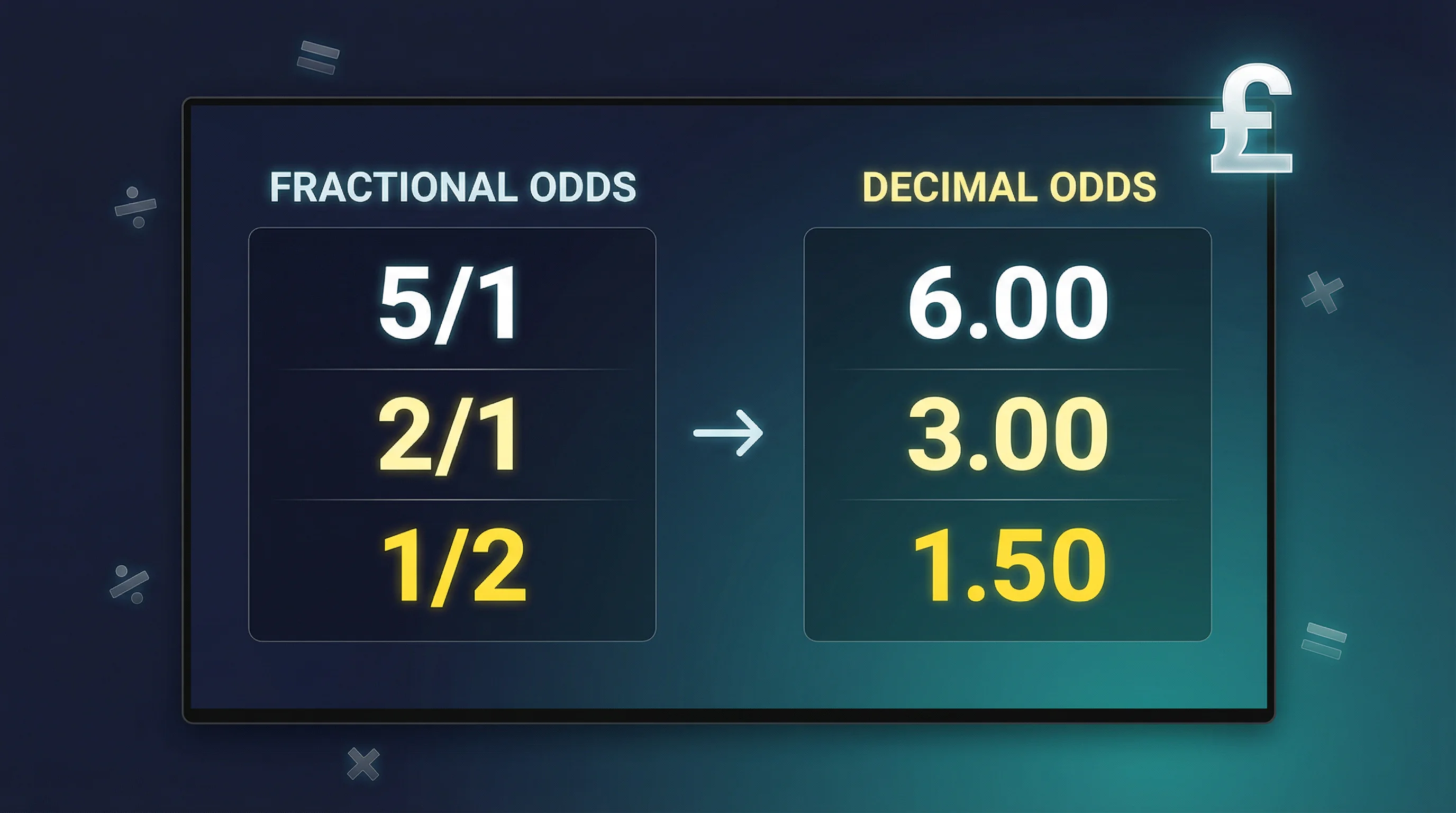
Fractional odds express potential profit relative to stake. Odds of 5/1 (spoken as “five to one”) mean you’ll profit £5 for every £1 staked if your bet wins, plus your original stake back. Your total return would be £6 — the £5 profit plus your £1 stake. Odds of 1/5 (spoken as “one to five” or “five to one on”) mean you’ll profit £1 for every £5 staked, returning £6 total from a £5 bet.
The fraction directly indicates the profit-to-stake ratio. The numerator (top number) shows profit; the denominator (bottom number) shows required stake. Odds of 9/4 mean £9 profit for every £4 staked. For a £10 bet at 9/4, multiply: (£10 × 9) ÷ 4 = £22.50 profit, plus your £10 stake back for £32.50 total return.
Even money — expressed as 1/1, evens, or EVS — represents the break-even point between “odds against” and “odds on.” At evens, you double your money if successful: £10 returns £20. Odds longer than evens (2/1, 5/1, 10/1) indicate the bookmaker considers that outcome less likely than not. Odds shorter than evens (1/2, 1/5, 1/10) indicate outcomes considered more likely than not.
Fractional odds remain dominant at traditional British bookmakers, particularly in horse racing and high-street betting shops. The format connects to centuries of British betting culture; many experienced punters find fractions more intuitive for quickly assessing relative value. Common odds like 11/10, 6/4, 9/2, and 7/1 become instinctively meaningful after modest exposure.
The main drawback is complexity when calculating returns on unusual fractions or combining multiple selections. Working out a £7.50 bet at 17/4 requires more mental effort than equivalent decimal calculation. For accumulators involving several selections, fractional arithmetic becomes genuinely tedious without calculator assistance.
Decimal Odds: The European Alternative
Decimal odds express total return per unit staked, including your original stake. Odds of 3.00 mean £3 total return for every £1 bet — equivalent to 2/1 fractional. Odds of 1.50 mean £1.50 total return for every £1 bet — equivalent to 1/2 fractional. The decimal figure multiplied by your stake gives total return directly.
Calculation simplicity represents decimal odds’ primary advantage. A £25 bet at 4.50 returns £25 × 4.50 = £112.50 total (£87.50 profit plus £25 stake). No fraction manipulation required; straightforward multiplication handles everything. For accumulators, multiply all decimal odds together, then multiply by stake. Four selections at 2.00, 1.80, 3.50, and 1.40 combine to 17.64. A £10 stake returns £176.40 if all four win.
Decimal odds also make probability assessment more transparent. The implied probability of any decimal odd is simply 1 divided by the odds. Decimal 2.00 implies 50% probability (1 ÷ 2.00 = 0.50). Decimal 4.00 implies 25% probability (1 ÷ 4.00 = 0.25). This direct relationship helps when evaluating whether offered odds represent value relative to your own probability assessment.
Most UK online bookmakers now default to decimal display or offer easy format switching. Betting exchanges like Betfair use decimal odds exclusively. Younger punters and those who started betting online often find decimals more intuitive, having never developed fractional fluency through traditional bookmaker exposure.
The transition between formats continues. Racecourses and traditional betting shops predominantly display fractional odds. Online platforms increasingly favour decimals. Both formats will likely coexist indefinitely, making basic fluency in both valuable for any UK punter navigating different betting environments.
Converting Between Formats and Finding Value
Converting fractional to decimal requires one step: divide the fraction, then add 1. Fractional 5/2 becomes (5 ÷ 2) + 1 = 3.50 decimal. Fractional 4/7 becomes (4 ÷ 7) + 1 = 1.57 decimal. Converting decimal to fractional reverses this: subtract 1, then express as a fraction. Decimal 2.75 becomes 1.75, which equals 7/4 fractional. Online converters handle this automatically, but mental conversion ability helps when comparing odds across differently formatted sources.
Implied probability — what odds suggest about outcome likelihood — matters more than raw numbers. To calculate implied probability from fractional odds: denominator ÷ (numerator + denominator). For 3/1: 1 ÷ (3 + 1) = 25%. For 1/3: 3 ÷ (1 + 3) = 75%. From decimal odds: 1 ÷ decimal. For 4.00: 1 ÷ 4 = 25%. For 1.33: 1 ÷ 1.33 = 75%.
Value betting — the foundation of profitable gambling — requires comparing implied probabilities against your own assessment. If you believe a team has 40% chance of winning and bookmakers price them at implied 30% probability (odds of 3.33 decimal or 7/3 fractional), that represents positive expected value. If you believe the true probability is only 20%, the same odds represent negative expected value despite the attractive-seeming numbers.
The bookmaker’s margin (overround) ensures implied probabilities across all outcomes sum to more than 100%. In a two-outcome market with fair odds, probabilities would total exactly 100%. In practice, a football match might show 45% + 28% + 32% = 105%, with that extra 5% representing bookmaker profit margin built into the odds. Lower overrounds mean better value for punters; comparing total implied probability across bookmakers reveals which offers better overall odds.
None of this guarantees winning bets — accurate probability assessment remains the hard part. But understanding odds mechanics prevents mistakes born from misreading what numbers actually represent.
Comparing Odds Across Bookmakers
Different bookmakers offer different odds on identical outcomes. The variation isn’t dramatic for mainstream markets — perhaps 10/11 at one operator versus 20/21 at another — but cumulative differences matter significantly over time. Odds comparison sites aggregate prices across major UK bookmakers, making best-odds identification straightforward.
Horse racing benefits from the “best odds guaranteed” feature that many UK bookmakers offer. Take early prices; if the starting price drifts higher, you receive the better odds. This effectively removes timing risk for racing bets and makes early price shopping valuable rather than risky.
For football and other sports without best odds guaranteed, timing matters alongside shop selection. Odds move as money arrives; popular selections typically shorten. Betting early locks in current prices but sacrifices information from later team news. Betting late incorporates more information but often at worse odds if the market has moved against you. Neither approach dominates universally; circumstances dictate which timing suits specific situations.
Multiple bookmaker accounts enable systematic best-odds betting. Rather than defaulting to a single operator, checking three or four before each bet ensures you’re not consistently accepting suboptimal prices. The administrative overhead is modest; the cumulative value can be substantial. Serious punters maintain accounts at numerous operators specifically to access best available prices consistently.
Speaking the Language
Odds fluency develops through exposure. Initially, converting between formats and calculating probabilities feels laborious. After modest practice, common odds become instantly meaningful — 6/4 registers as roughly 40% implied probability without conscious calculation. This fluency speeds decision-making and reduces errors that come from misinterpreting what prices actually mean.
The underlying principles matter more than mechanical conversion skills. Odds represent bookmaker opinions about probabilities, adjusted to ensure their profit. Higher odds mean larger potential payouts but lower assessed likelihood of success. Comparing odds across operators finds better prices; comparing implied probabilities against your own assessments identifies potential value. These concepts apply regardless of which format you prefer.
British betting culture maintains attachment to fractional odds, particularly in racing. The language of “fives,” “even money,” and “odds on” carries tradition that decimal notation lacks. But practicality increasingly favours decimals, especially for complex calculations. Neither format contains information the other lacks — they’re simply different expressions of identical underlying mathematics. Learning to work comfortably in both positions you to operate confidently across the full range of UK betting environments, from racecourse rails to online exchange platforms.
Find all betting guides at onlinegamblinguk. Also read our UK sports betting.