

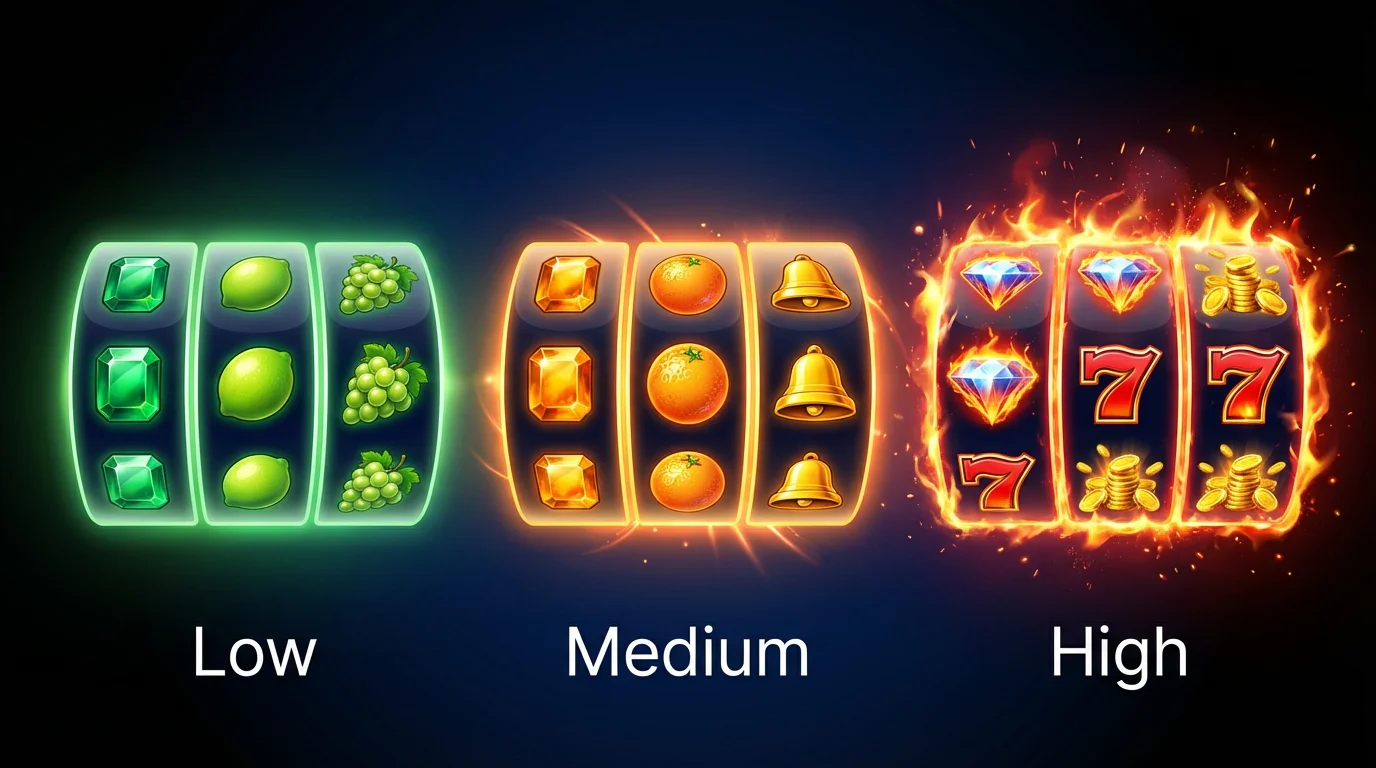
What Volatility Actually Means
Every slot game comes with an RTP figure — the percentage of staked money that theoretically returns to players over millions of spins. But RTP tells you nothing about the experience of actually playing. Two slots with identical 96% RTP can feel completely different. One might pay out small amounts frequently, keeping your balance relatively stable. Another might drain your bankroll through long dry spells before potentially delivering substantial wins. This difference in payment pattern is volatility.
Volatility — sometimes called variance — describes how a slot distributes its returns. High volatility means larger but less frequent wins. Low volatility means smaller but more frequent payouts. Neither is objectively better. Each suits different playing styles, bankroll sizes, and session goals. The challenge is that volatility isn’t always clearly communicated, and mismatched expectations lead to frustration even on perfectly functional games.
Understanding volatility transforms how you approach slot selection. It’s not about finding games that pay more — RTP handles that calculation. It’s about finding games that pay in patterns matching your preferences. A player with a modest bankroll seeking extended entertainment has fundamentally different needs than someone willing to risk faster losses for a shot at larger wins. Volatility determines which experience you’ll actually get.
Low Volatility Slots
Low volatility slots prioritise consistency over dramatic swings. Wins come frequently — sometimes multiple times per spin through partial payline hits — but individual payouts tend to be modest relative to stake. Your balance fluctuates gently rather than lurching between extremes. Sessions feel steadier, even predictable by slot standards.
The mathematics behind low volatility involves weighted symbol distribution. These games typically feature more winning combinations but cap the multipliers on major wins. A low volatility slot might hit winning spins 30-35% of the time, compared to perhaps 20% or less for high volatility alternatives. But those wins are more likely to be 1x, 2x, or 5x your stake rather than 50x or 500x.
This pattern suits several playing scenarios. Limited bankrolls benefit from the extended playtime low volatility provides — your money lasts longer, which matters if entertainment is the primary goal. Wagering bonus requirements through low volatility slots involves less risk of dramatic losses during the playthrough period, though the flip side is that big wins to offset wagering are less likely. Players who prefer relaxed, unhurried sessions without the anxiety of watching balances plummet often gravitate toward these games.
Classic three-reel slots often fall into the low volatility category, as do many branded entertainment titles designed for casual play. Games from providers like NetEnt frequently feature lower volatility options, though provider alone doesn’t guarantee any specific volatility level. The trade-off is straightforward: you sacrifice the possibility of transformational wins for more predictable, smaller returns that keep sessions alive longer.
High Volatility Slots
High volatility slots operate on feast-or-famine principles. Long stretches produce nothing or trivial returns that don’t cover stakes. Then, occasionally, significant wins arrive — potentially hundreds or thousands of times your bet. The overall RTP might match a low volatility alternative, but the journey feels entirely different.
These games front-load their prize structures into bonus features and rare symbol combinations. Base game wins exist but rarely impress. The excitement — and the mathematical expectation — concentrates in free spin rounds, multiplier chains, or expanding wilds that transform ordinary spins into substantial payouts. Triggering these features becomes the session’s objective; everything else is essentially marking time.
Bankroll requirements increase substantially with high volatility. A hundred spins might easily produce zero meaningful wins, which means your starting balance needs to sustain that possibility without depleting entirely. Professional slot streamers often demonstrate high volatility games precisely because the dramatic swings create compelling viewing — but their bankrolls typically exceed what recreational players should risk. The Instagram highlight reel of massive wins obscures the routine reality of extended losing periods.
Megaways slots, which feature dynamic reel sizes creating thousands of potential paylines, typically fall into high volatility territory. Games from providers like Big Time Gaming and Push Gaming often emphasise high volatility mechanics. Bonus-buy features — where available under UK regulations — let players skip directly to bonus rounds at a premium cost, essentially compressing volatility into immediate high-stakes outcomes. These features suit players who specifically want high volatility exposure without base game waiting periods, though the premium typically exceeds expected value compared to triggering naturally.
Medium Volatility and the Spectrum Between
Volatility isn’t binary. Most slots fall somewhere along a spectrum, with medium volatility occupying the broad middle ground between extremes. These games balance frequency and size, offering more substantial wins than low volatility options without the extended droughts characteristic of high volatility play.
Medium volatility suits players who want variety within sessions — periods of smaller, steadier wins punctuated by occasional larger payouts. The experience feels less predictable than low volatility without demanding the bankroll resilience that high volatility requires. Many popular games occupy this territory precisely because it appeals to the widest range of players.
Identifying where a specific game falls on the volatility spectrum isn’t always straightforward. Some providers publish volatility ratings; others don’t. When disclosed, ratings might use terms like “low,” “medium,” “high,” or numbered scales (1-5, for instance), but no universal standard exists. A “medium-high” rating from one provider might correspond to “high” from another. Game review sites and player communities often provide useful guidance based on actual play experience, filling gaps in official documentation.
Paytable analysis offers indirect clues. Games with large gaps between minimum and maximum wins — where the top payout dramatically exceeds typical returns — usually indicate higher volatility. Games with more evenly distributed prizes suggest lower volatility. Bonus feature frequency and the proportion of total RTP delivered through base game versus features also signals volatility characteristics. Games that concentrate most returns in rare bonus rounds play differently from those distributing value more evenly across all spin types.
The absence of standardised volatility disclosure remains a genuine gap in UK slot regulation. RTP disclosure is mandatory under UKGC Remote Technical Standards; volatility disclosure isn’t. Players must often rely on third-party information or trial experience to understand what they’re actually selecting.
Matching Volatility to Your Bankroll
Bankroll sizing should account for volatility directly. A £50 session bankroll on high volatility slots might sustain only 50 spins at £1 stakes — entirely inadequate given that meaningful wins could require hundreds of spins to materialise. The same bankroll on low volatility games might stretch considerably further, delivering the extended entertainment some players seek.
A rough framework: high volatility games warrant starting bankrolls that can sustain 200-300 spins at your chosen stake. This doesn’t guarantee winning sessions — nothing does — but it provides sufficient runway for volatility to express itself across multiple bonus opportunities. Medium volatility might require 100-150 spins equivalent; low volatility potentially less.
Stake sizing follows from this logic. If your session budget is £100 and you want to play a high volatility game properly, stakes around £0.30-0.50 per spin make more mathematical sense than £2 spins that risk depleting before the game’s mechanics have opportunity to perform. This constraint frustrates players who prefer higher stakes, but the alternative — burning through budgets before variance has any chance to work in your favour — frustrates more.
Session goals matter too. Someone wagering through bonus requirements might intentionally choose low volatility to minimise balance swing risk during playthrough. Someone seeking occasional large wins might prefer high volatility despite lower hit frequency. Neither approach is wrong; both align strategy with objectives. The mistake is mismatching — choosing high volatility with insufficient bankroll, or expecting exciting large wins from games designed for steady, modest returns.
Choosing Your Risk Level
Volatility preference is personal, not prescriptive. Some players genuinely enjoy the tension of high volatility play — the anticipation of bonus triggers, the possibility of significant wins that make previous losses irrelevant. Others find that experience stressful rather than entertaining and prefer the steadier rhythm of low volatility games. Neither preference indicates sophistication or its absence.
What matters is informed selection. Knowing a game’s volatility before committing money allows appropriate bankroll sizing and realistic expectation setting. Feeling disappointed that a high volatility slot didn’t pay frequently, or frustrated that a low volatility game’s wins feel insignificant, suggests misaligned understanding rather than game defects.
Volatility also interacts with RTP in ways worth noting. A low volatility 94% RTP slot will erode your balance more reliably than a high volatility 96% RTP alternative — but the high volatility option might deplete your session bankroll completely before variance evens out. Long-term mathematical expectation and session-level experience diverge, and volatility determines how dramatically they diverge. Understanding both dimensions — the statistical return and the experiential journey — makes for more satisfying play regardless of which volatility profile you ultimately prefer.
Find more slot guides at onlinegamblinguk. Also read our RTP and house edge explained.