

The Numbers That Define Your Odds
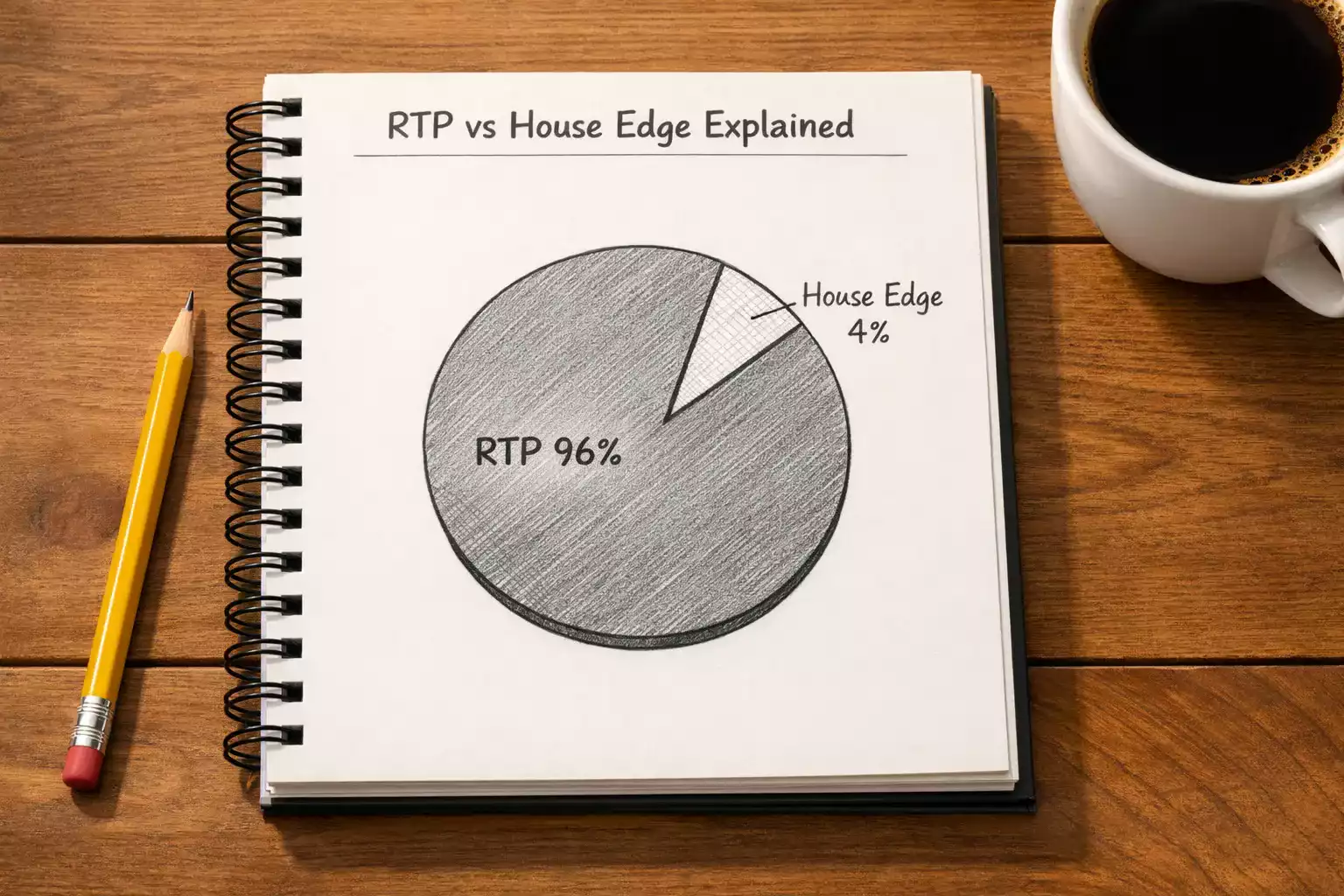
Every casino game has a mathematical foundation that determines who wins over time. Two numbers capture this reality: Return to Player (RTP) and house edge. They’re two sides of the same coin—literally. If a game returns 96% to players, the house keeps 4%. Understanding these percentages is the difference between gambling with awareness and gambling blind.
UK regulations require licensed casinos to display RTP information for their games. This transparency exists because regulators want players to make informed decisions. The numbers are publicly available, clearly disclosed, and mathematically precise. Whether players actually look at them is another matter.
Most don’t. The excitement of the game, the hope of a big win, the immersive design—these dominate attention. The dry percentages in a game’s information screen seem abstract and distant from the experience of actually playing. But those percentages determine outcomes more reliably than any other factor.
The house edge guarantees that, collectively, players lose and casinos profit. This isn’t corruption or cheating—it’s the business model, disclosed openly, built into every game by design. Individual sessions produce winners and losers through variance, but the long-term mathematics are fixed.
Learning to read RTP and house edge won’t make you a winner. Nothing can overcome the mathematical advantage built into casino games. But it will help you understand what you’re paying for entertainment, which games cost more than others, and why some bets are particularly poor value.
What RTP Actually Means
RTP stands for Return to Player, expressed as a percentage. A slot with 96% RTP theoretically returns £96 for every £100 wagered on it over its lifetime. The remaining £4 goes to the casino. This calculation encompasses all play on that game across all players—millions of spins aggregated into a single figure.
The critical word is “theoretically.” RTP describes long-term mathematical expectation, not what happens in any individual session. You might play a 96% RTP slot and lose everything. You might play the same slot and win ten times your stake. Both outcomes are consistent with the stated RTP because the percentage only manifests across enormous sample sizes.
Think of it this way: if a million players each wagered £100 on a 96% RTP slot, the collective results would approximate £96 million returned and £4 million retained by the casino. But those aggregate results distribute unevenly across individuals. Some players contribute disproportionately to the casino’s profit; others walk away as winners. The RTP tells you nothing about which group you’ll join.
Variance explains the disconnect between theoretical returns and actual experience. High variance games produce wild swings—extended losing streaks punctuated by occasional large wins. Low variance games deliver steadier results with smaller individual payouts. The RTP might be identical; the playing experience differs completely.
UK online slots typically range from 94% to 97% RTP. A few fall outside this range in either direction. The difference between 94% and 97% might seem trivial, but over extended play, it compounds. At 94% RTP, you’re paying £6 per £100 wagered; at 97%, you’re paying £3. The cheaper game costs half as much in expectation.
Game providers set RTP during development. Some slots have configurable RTP, allowing casinos to choose from several options. UK regulation requires the actual RTP in use to be disclosed—not a theoretical maximum that the casino isn’t actually offering.
House Edge Across Different Games
House edge is simply 100% minus RTP. A game with 96% RTP has a 4% house edge. The terminology differs—house edge emphasises what the casino takes; RTP emphasises what players receive—but the mathematics are identical.
Different game categories carry characteristic house edges. Online slots typically run 3-6% house edge, with most clustered around 4%. This makes slots one of the more expensive forms of casino gambling, though the entertainment value and jackpot potential attract players regardless.
Blackjack offers dramatically better odds—if played correctly. With perfect basic strategy, the house edge drops below 0.5% in favourable rule variations. Without strategy, casual players face edges of 2% or more. The game rewards knowledge in ways that slots cannot.
Roulette varies by wheel type. European roulette carries a 2.7% house edge. American roulette, with its additional double zero, jumps to 5.26%. French roulette with la partage rules drops to 1.35% on even-money bets. The choice of wheel matters more than any betting pattern.
Baccarat offers relatively favourable odds. Betting on banker carries approximately 1.06% house edge; betting on player runs about 1.24%. The tie bet, at roughly 14.36% house edge, is one of the worst wagers in any casino.
Video poker, when played with optimal strategy on full-pay machines, can approach or even exceed 100% RTP in rare cases. More commonly, edges run 0.5-5% depending on the specific variant and paytable. Like blackjack, the game rewards study.
Live casino games and game shows vary widely. Traditional table games maintain standard edges. Game show formats like Crazy Time typically carry higher house edges than classic games—you’re paying for the enhanced entertainment value.
Sports betting works differently. The bookmaker’s margin functions like house edge but applies to specific markets rather than games. Competitive football markets might run 3-5% margin; obscure markets can exceed 10%.
Why These Numbers Matter for Your Bankroll
The house edge represents the cost of playing. Understanding this reframes gambling from “trying to win money” to “paying for entertainment that might occasionally pay back.” The framing matters because it aligns expectations with mathematical reality.
Consider a player wagering £1,000 over an evening session. At a 4% house edge game, the expected loss is £40. At a 1% house edge game, the expected loss drops to £10. The actual session might produce anything from significant wins to total bankroll depletion, but the expected cost differs fourfold between these games.
Turnover amplifies the impact. Slots allow rapid wagering—hundreds of spins per hour at stakes that compound quickly. A player betting £1 per spin at 600 spins per hour puts £600 through the game hourly. At 4% house edge, that’s £24 per hour in expected cost. Table games typically run slower, reducing total turnover and therefore total expected loss per hour even when house edges are comparable.
Bonus wagering makes house edge particularly important. If you must wager a £100 bonus 20 times (£2,000 total), the game’s house edge determines how much of that bonus survives. At 4% edge, you’d expect to lose £80 to the house edge alone. At 1% edge, you’d lose £20. The bonus value depends heavily on which games you play while clearing it.
Session variance means individual results diverge wildly from expectation. You can absolutely beat the house edge in a single session—variance makes this common. But the more you play, the more your results converge toward the mathematical expectation. The house edge isn’t a tax on every spin; it’s a gravitational pull that becomes irresistible over time.
Choosing lower house edge games doesn’t guarantee better sessions. It does mean that, across all your gambling, you’ll retain more of your money than if you played higher edge games. The difference compounds over months and years of play.
Finding and Using RTP Information
UK-licensed casinos must disclose RTP for their games. Finding this information varies by site and game type, but it’s always available if you look.
For slots, check the game’s information or help section. Most games include a paytable screen that lists the RTP alongside other details. The figure might appear as “RTP: 96.5%” or “Return to Player: 96.5%” or similar wording. Some casinos list RTP in a central games directory rather than within each individual game.
For table games, RTP depends on how you play. Blackjack’s theoretical RTP assumes perfect strategy; actual RTP for a typical player is lower. Roulette’s RTP is fixed by the wheel type and bet selections. Casinos may state the theoretical optimal RTP, which represents the best possible case.
Compare before you play. If two similar slots appeal to you, the one with higher RTP costs less in expectation. A 2% difference in RTP—say, 94% versus 96%—means one game takes twice as much per pound wagered. Over any significant playing volume, this adds up.
Beware of configurable RTP. Some game providers allow casinos to select from multiple RTP settings. A slot might be available at 96%, 94%, or 92% RTP depending on the operator’s choice. UK regulations require disclosure of the actual setting in use, not just the theoretical maximum. If you see the same game at different casinos, the RTP might differ.
Use RTP as one factor, not the only factor. A slightly lower RTP game you enjoy might be preferable to a higher RTP game that bores you. Entertainment value matters—you’re paying for the experience either way. But understand what you’re paying, and don’t ignore substantial RTP differences when choosing between otherwise similar options.
The Numbers Don’t Lie
RTP and house edge are the most honest things about casino gambling. They disclose exactly what the games are designed to do: return most of the money wagered while retaining a percentage for the house. No mystery, no hidden mechanics, just mathematics operating as advertised.
This honesty doesn’t make gambling safe or profitable. The house edge guarantees that collective player losses fund casino profits. Individual variance creates winners, but the system overall extracts money from players by design. Understanding the numbers simply means understanding the game you’re playing.
Players who ignore RTP and house edge aren’t protected from them. The mathematics apply whether you know about them or not. Ignorance just means you can’t make informed choices about which games cost more and which cost less. You pay either way; awareness at least lets you minimise the cost.
The best use of this knowledge is realistic expectation-setting. Gambling is entertainment with a price. The house edge tells you what that price is. A 4% house edge means you’re paying £4 per £100 wagered for the experience. Whether that’s good value depends on how much entertainment you derive—but at least you know what you’re buying.
Some players use RTP to chase better odds across games and casinos. This makes mathematical sense up to a point. But no amount of RTP optimisation overcomes the fundamental reality: the house edge exists, it applies to every bet, and it ensures that playing more means paying more. The numbers are clear about this. They don’t lie, and they don’t make exceptions.
Get more casino tips at onlinegamblinguk. Also read our slot volatility explained.